Free guide · 8 pages · PDF
Two people. The workload of ten.
The AI-native go-to-market setup for sales-led B2B SaaS and AI companies past roughly €2M ARR. Agents handle the recurring work, people make the calls. With the math, the guardrails that keep it safe, and a self-check for your team.
Read the guide for free
Sign up quickly and go straight to the PDF, with no forced newsletter.
Your details are processed via HubSpot when you submit. Details in the privacy policy.
Instant access · 8 pages · English
77 h
instead of 400 h a week
8
agents on a schedule
5
weeks to live
8
pages · DE · EN
- The math in the open: ten roles, broken down by type of work
- The eight knowledge base modules with owners and cadence
- Eight agents, two roles and a morning in the hub
- The permission ladder L0–L3 and the go budget
- An eight-question self-check and the roadmap for the first five weeks
The idea in one picture
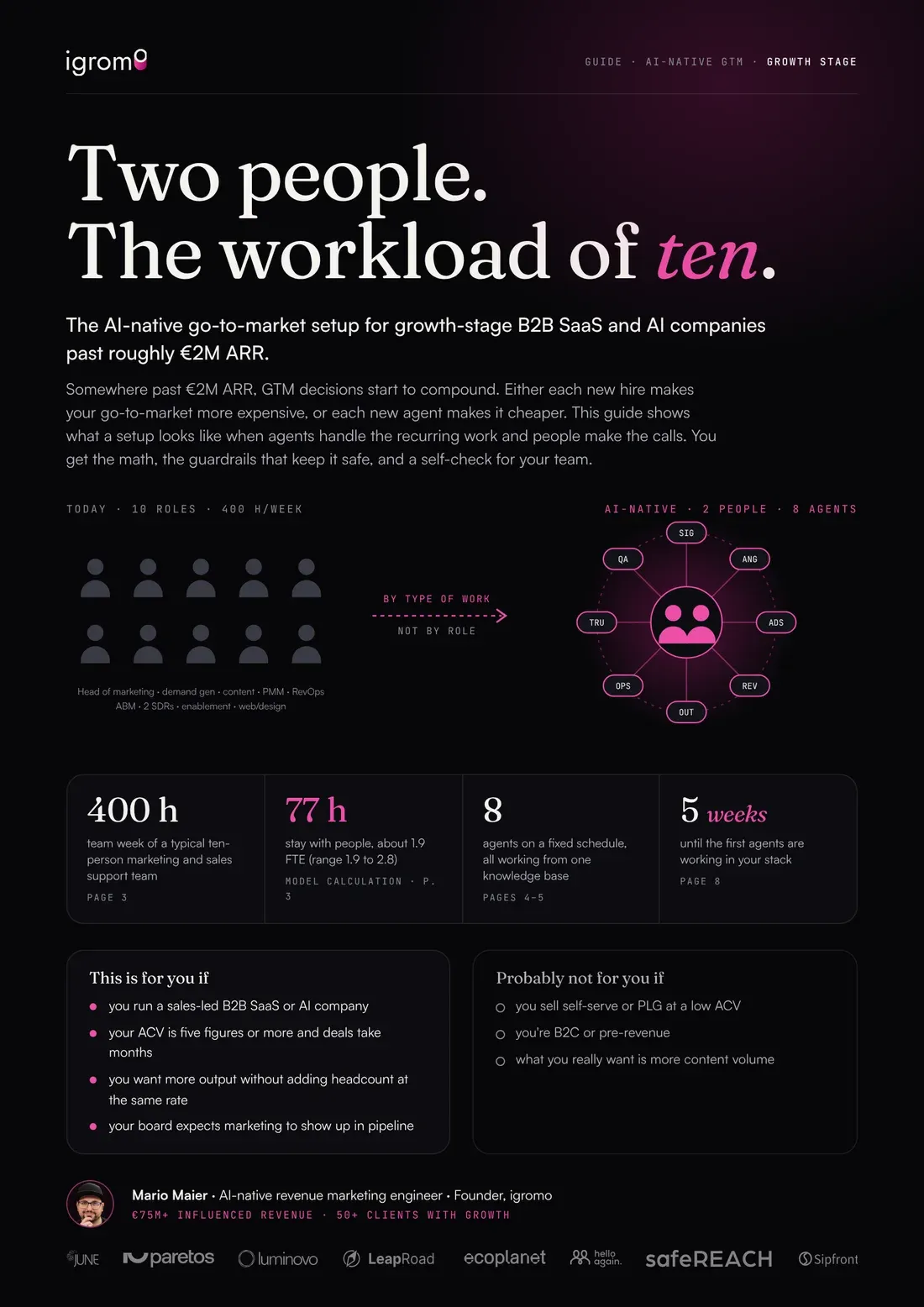
Work by type, not by role.
An agent covers one type of work across several roles. Weekly prep, for example, used to bounce between the head of marketing and RevOps. That's how two people with eight agents cover the task inventory of ten.
Today · 10 roles · 400 h a week
Head of marketing · demand gen · content · PMM · RevOps · ABM · 2 SDRs · enablement · web/design
AI-native · 2 people · 8 agents
- SIGSignalcontinuously
- ANGAngle & contenton demand
- ADSPaid mediadaily
- REVPipeline reportingweekly
- OUTOutreach routingdaily
- OPSInbox & opstwice a day
- TRUProduct truthweekly
- QAQA & brand guardtwice a day
Why the system comes first
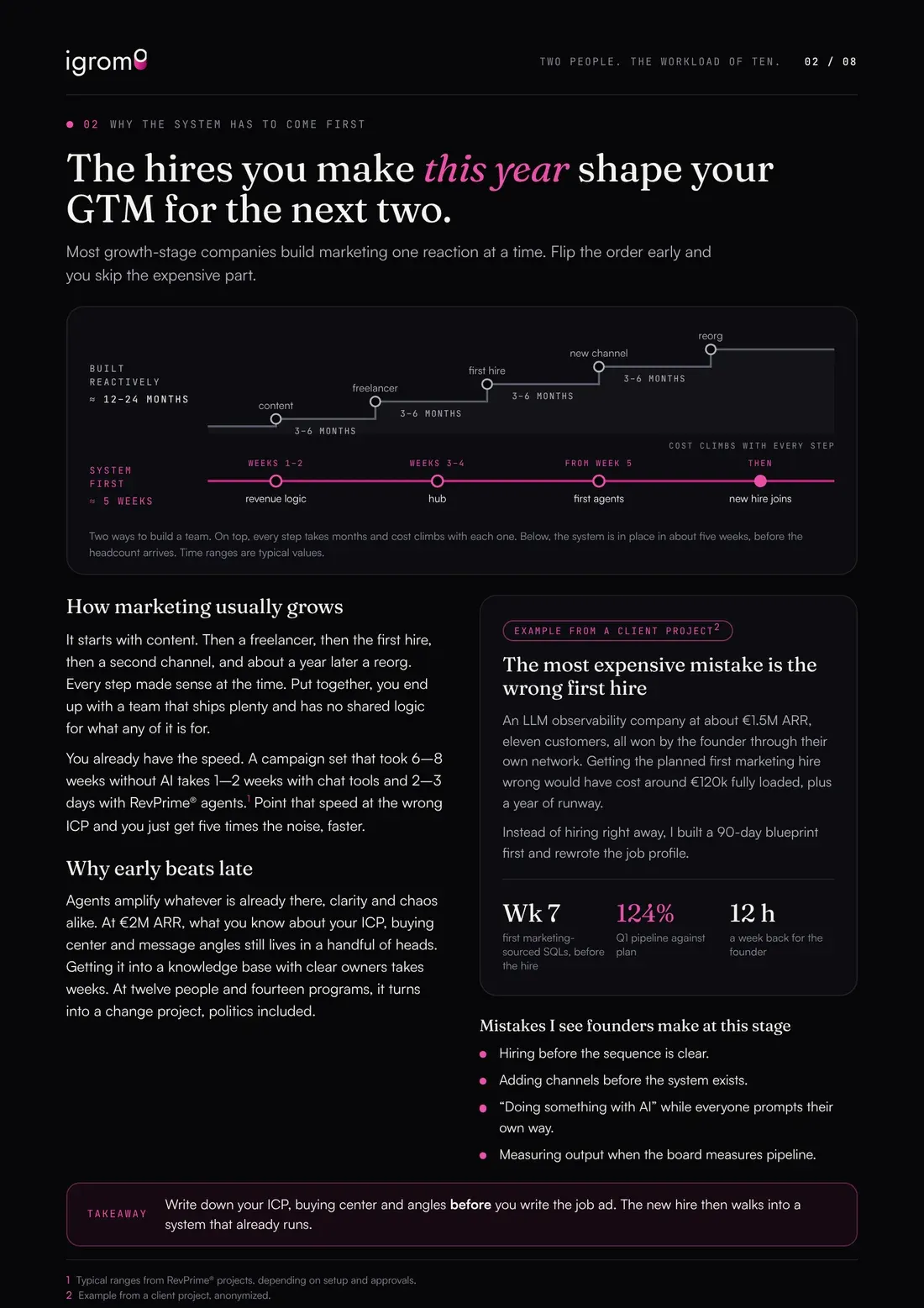
Months per step. Or five weeks for all of it.
Most growth-stage companies build marketing one reaction at a time. Every step takes months, and cost climbs with each one. Flip the order and the system is in place before the headcount arrives.
Built reactively
≈ 12–24 months
- Content3–6 months
- Freelancer3–6 months
- First hire3–6 months
- New channel3–6 months
- Reorg3–6 months
Cost climbs with every step
System first
≈ 5 weeks
- Weeks 1–2Revenue logic
- Weeks 3–4Hub
- From week 5First agents
- ThenNew hire joins
Revenue logic and the knowledge base come first, the first agents go live in week 5. Your next hire walks into a system that already runs. In one project, the first marketing-sourced SQLs came in week 7, before the new hire had even started.
Time ranges are typical values.
The math
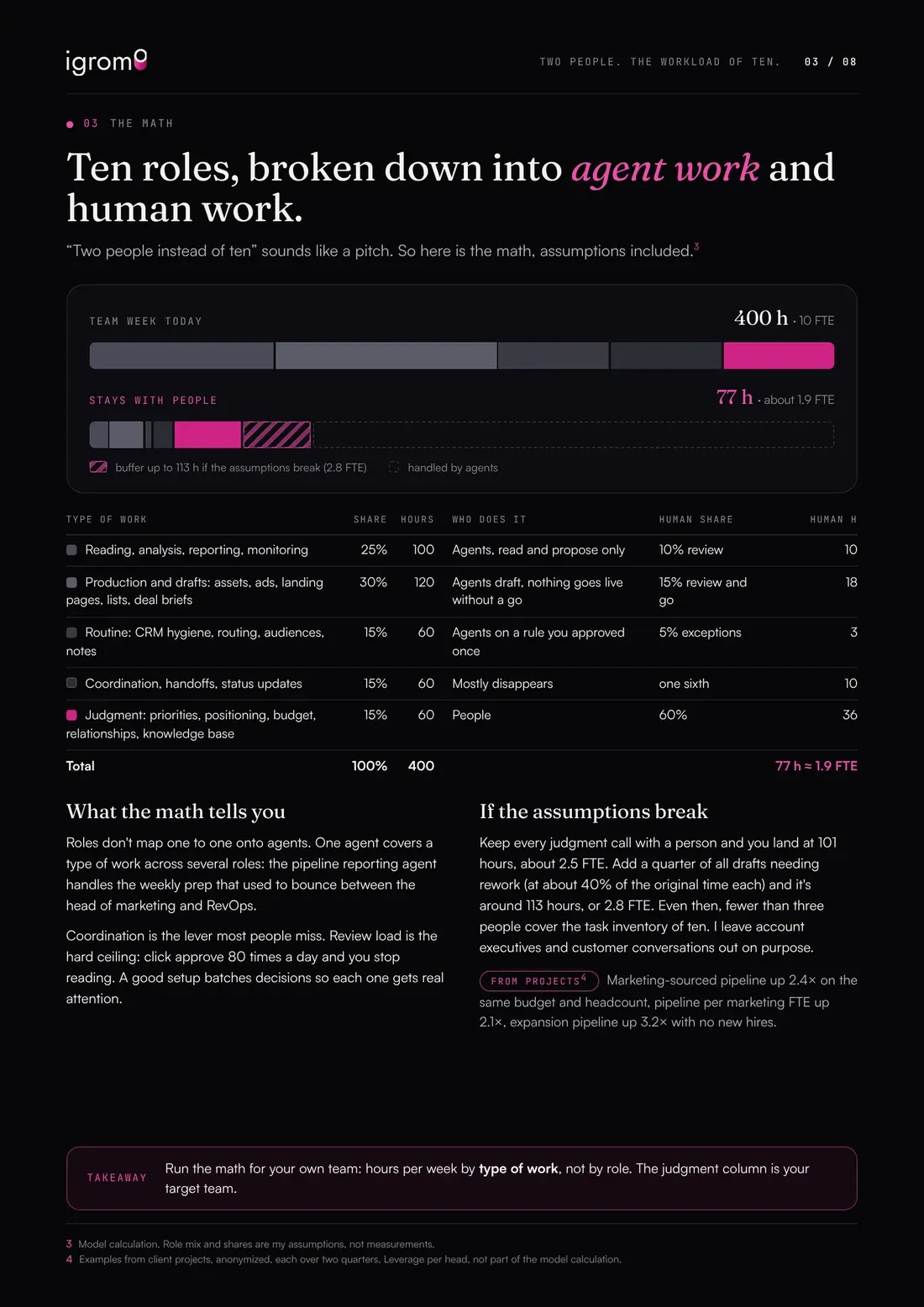
A 400-hour team week. 77 stay with people.
“Two people instead of ten” sounds like a pitch. So the guide shows the math, assumptions included. Even if they break, you land at 2.8 FTE.
Buffer up to 113 h if the assumptions break
| Reading, analysis, reporting | 100 h | 10 h |
| Production and drafts | 120 h | 18 h |
| Routine: CRM, routing, audiences | 60 h | 3 h |
| Coordination, handoffs, status | 60 h | 10 h |
| Judgment: priorities, budget, relationships | 60 h | 36 h |
Model calculation. Role mix and shares are assumptions, not measurements.
Governance
No agent changes anything without a go.
Agents only move as fast as leadership trusts them. Each agent gets exactly one level per tool, and anything that goes out or moves budget always needs a single go.
- L0
Read
Read CRM, ads, web and docs for analysis
- L1
Propose
Numbered proposals, nothing changes in the tool
- L2
Write after go
After a single go, write into the tool and log it
- L3
Approved rule
A narrow routine, revocable any time
What's inside
8 pages. One setup.
Eight pages you can read in half an hour. Each one ends with something you can act on by Monday.
- 01
The idea
Two people, eight agents, and who the setup is built for.
- 02
Why the system comes first
Two ways to build a team, and the most expensive mistake: the wrong first hire.
- 03
The math
A 400-hour team week, broken down by type of work, assumptions included.
- 04
The knowledge base
Five layers and eight modules with owners, cadence and who reads what.
- 05
Agents & hub
Eight agents with schedule and permission level, two roles, a morning in the hub.
- 06
Governance
Permission ladder, change log, what a proposal looks like, and the go budget.
- 07
Self-check
Eight questions to tick. Afterwards you know where you stand.
- 08
Roadmap
Five weeks to your first agents, and how you get there.
A look inside
What it looks like inside.
Why the system comes first The math 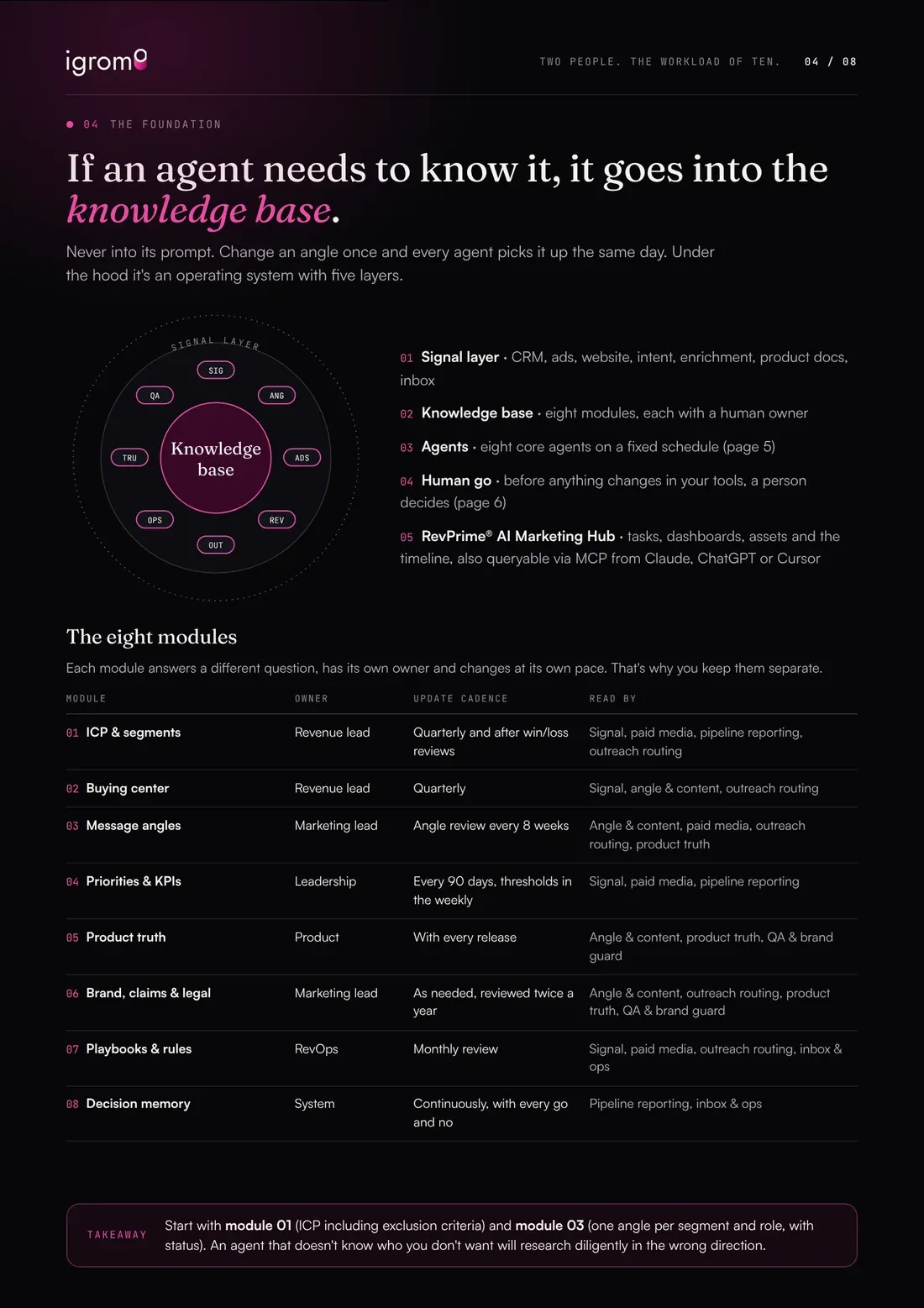
The knowledge base 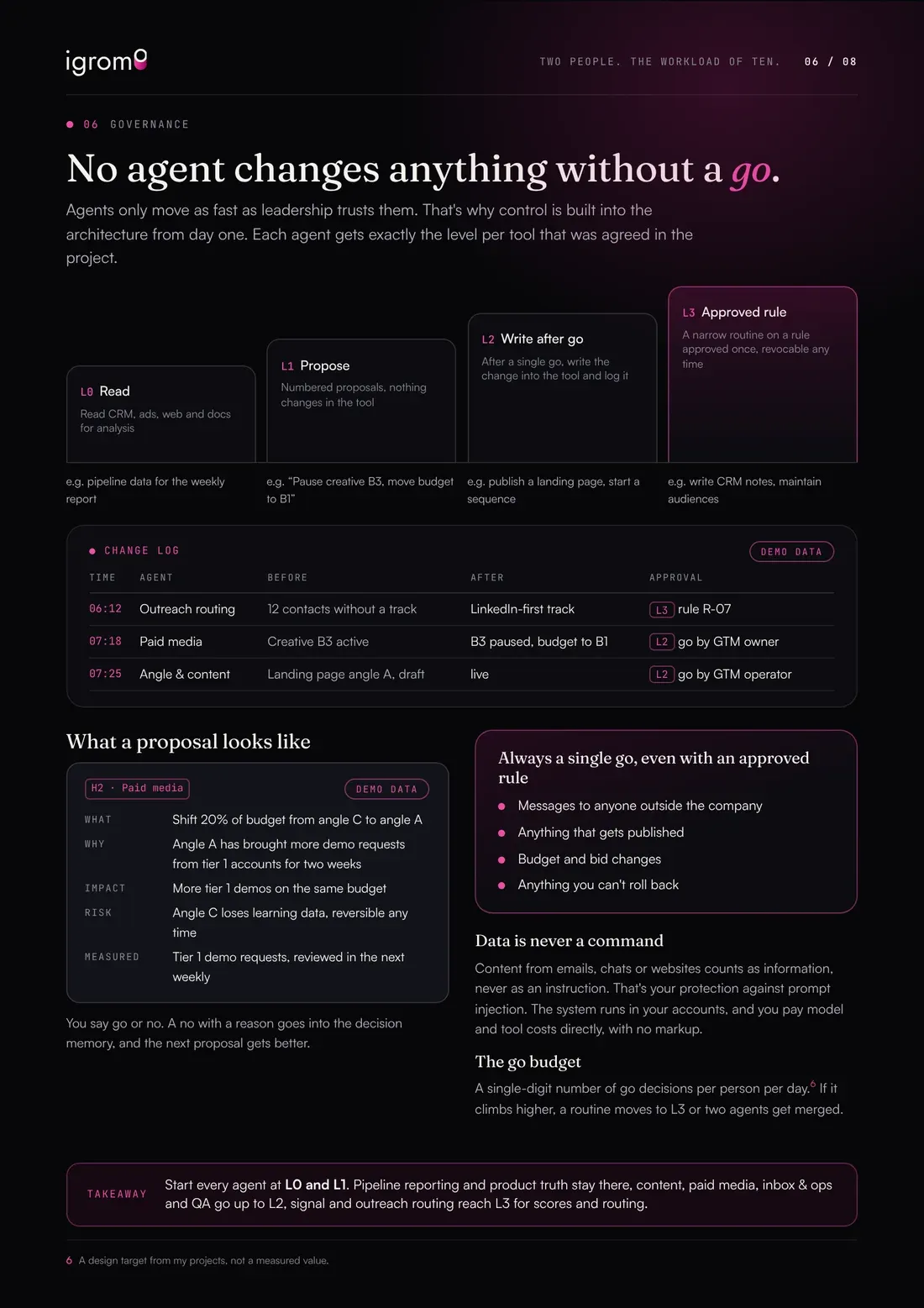
Governance 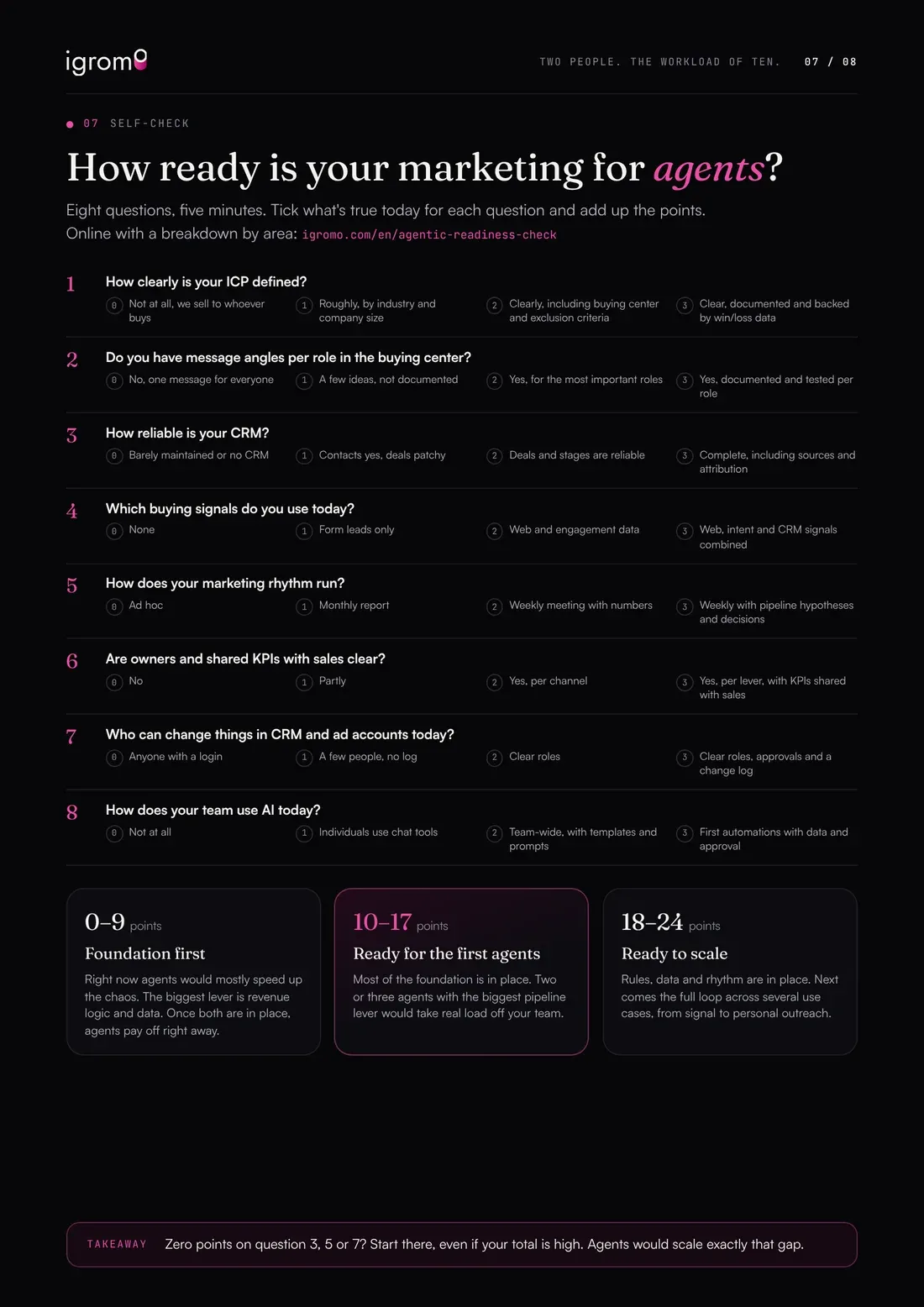
Self-check
Who it's for
For founders who want more done with the team they have.
- You run a sales-led B2B SaaS or AI company past roughly €2M ARR.
- Your ACV is five figures or more and deals take months.
- You're planning your next marketing hires and want the order right.
- Your board expects marketing to show up in pipeline.
Two people. The workload of ten.
Written by Mario Maier, AI-native revenue marketing engineer and founder of igromo. €75M+ influenced revenue, 50+ clients with growth.
Go to the form