Agency, fractional CMO, in-house team or agent system: how B2B SaaS founders decide
Fractional CMO vs agency is how many founders of B2B SaaS and AI companies with €1M to €25M in revenue frame the question. There are really four options, because the first in-house hire and an AI agent system belong on the list too. I compare all four against seven criteria, show when each fits and lay out the cost logic. I sell one of them myself, so I've also written down when it's the wrong choice.
 ByMario Maier
Published 12 min read
Contents
- Four ways to add marketing capacity
- What each option actually gives you
- Seven criteria for the decision
- Agency vs. fractional CMO vs. in-house team vs. agent system
- When each option fits
- Cost logic: what you pay for with each option
- When RevPrime® is the wrong choice
- Example: before the first marketing hire at about €1.5M ARR
- Common mistakes when founders decide
- Making the call in 30 days
- My recommendation
Four ways to add marketing capacity
I've had this conversation with many founders. You've carried sales yourself, mostly through your network. Now pipeline has to come from more than your contacts, and there's a real marketing budget for the first time. That's when the comparison starts: fractional CMO vs agency, a first full-time hire, or a system of AI agents.
Each of the four is sound in the right situation. The offers sound alike, though, so I sort them by two things: what you're actually buying, and who holds the knowledge once the work is done.
Agents have also changed what capacity means. A campaign set that took 6 to 8 weeks without AI takes 1 to 2 weeks with chat tools and 2 to 3 days with RevPrime® agents, typical ranges from my projects.
A disclosure first. With RevPrime® I build one of the four options, an agentic marketing operating system. I'll describe the other three as fairly as I can.
Pick the option by the gap you need to close, and by where the knowledge should live when the engagement ends.
What each option actually gives you
These are the definitions I use.
Agency
An agency produces output in one or more channels, such as paid media, SEO, content or design, for a monthly retainer or a project fee. You get capacity from day one and specialist depth gathered across many client accounts.
Its usual limit is the brief, and pipeline accountability rarely makes it into the contract.
Fractional CMO
A fractional CMO is a senior marketing leader working part time, often a few days a week or a month, on positioning, budget, first hires, team leadership and the board. You get senior judgment before a full-time executive makes financial sense.
Time and the person set the limits. You still need people or agents to carry out the work, and if the reasoning behind decisions never lands in your systems, it leaves with that person.
In-house team
This means your first full-time marketing hire and, later, a small team. Your own people have context, sit close to sales and product, and ideally stay for years. For relationship work like partnerships or community, that's hard to replace.
Speed and risk are the limits. When marketing grows reactively, from content to a freelancer to the first hire, my guide puts each step at a typical 3 to 6 months.
Agent system
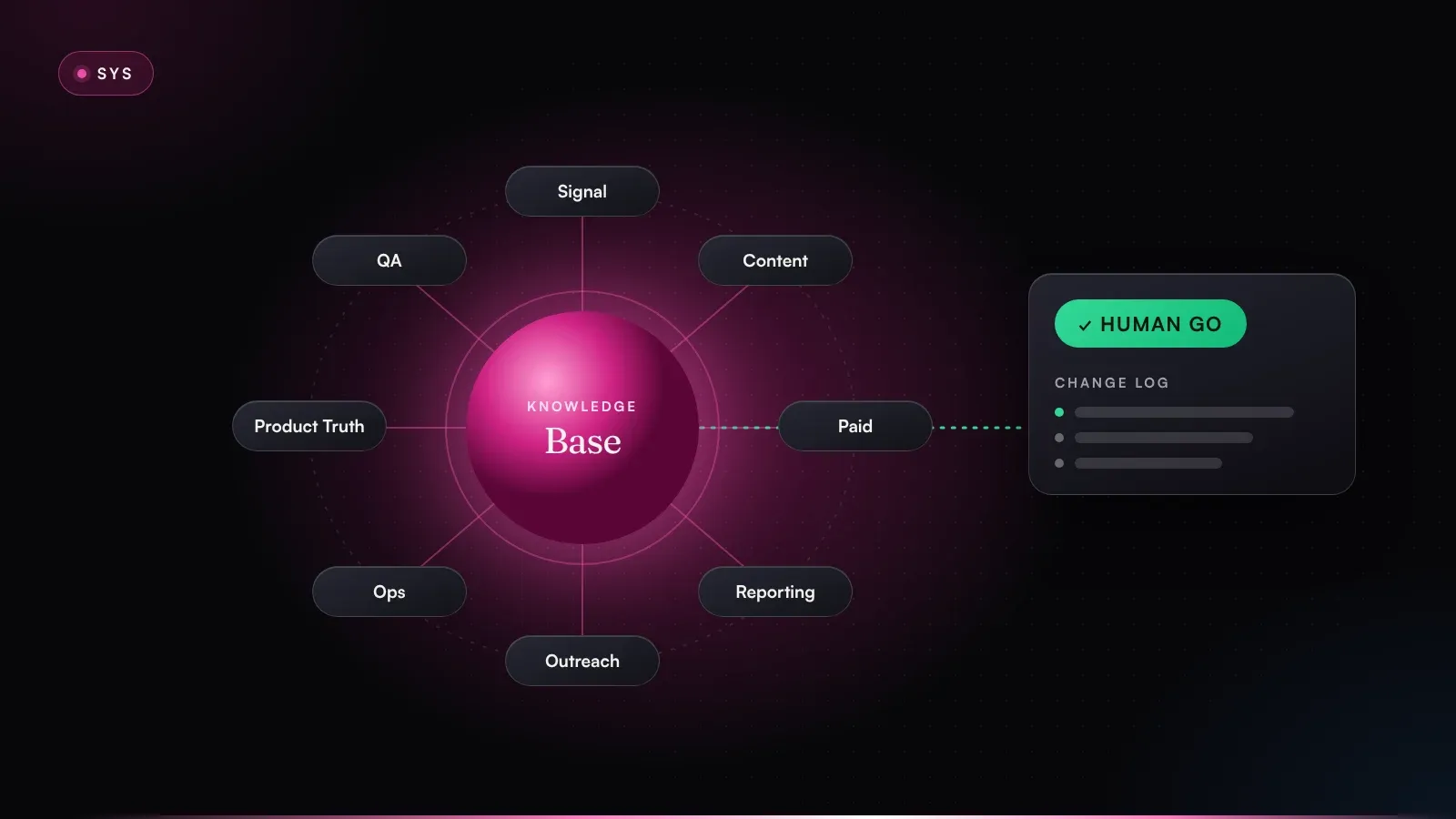
An agentic marketing system combines a knowledge base holding your revenue logic, specialized agents with one job each, and a human go before anything with external effect. In RevPrime® that means eight core agents, for signals, content drafts, paid media, pipeline reporting and more, plus a permission ladder from L0 (read) to L3 (approved rule), all running in your own accounts. I cover the architecture in my guide to AI agents for B2B marketing and on the RevPrime® page.
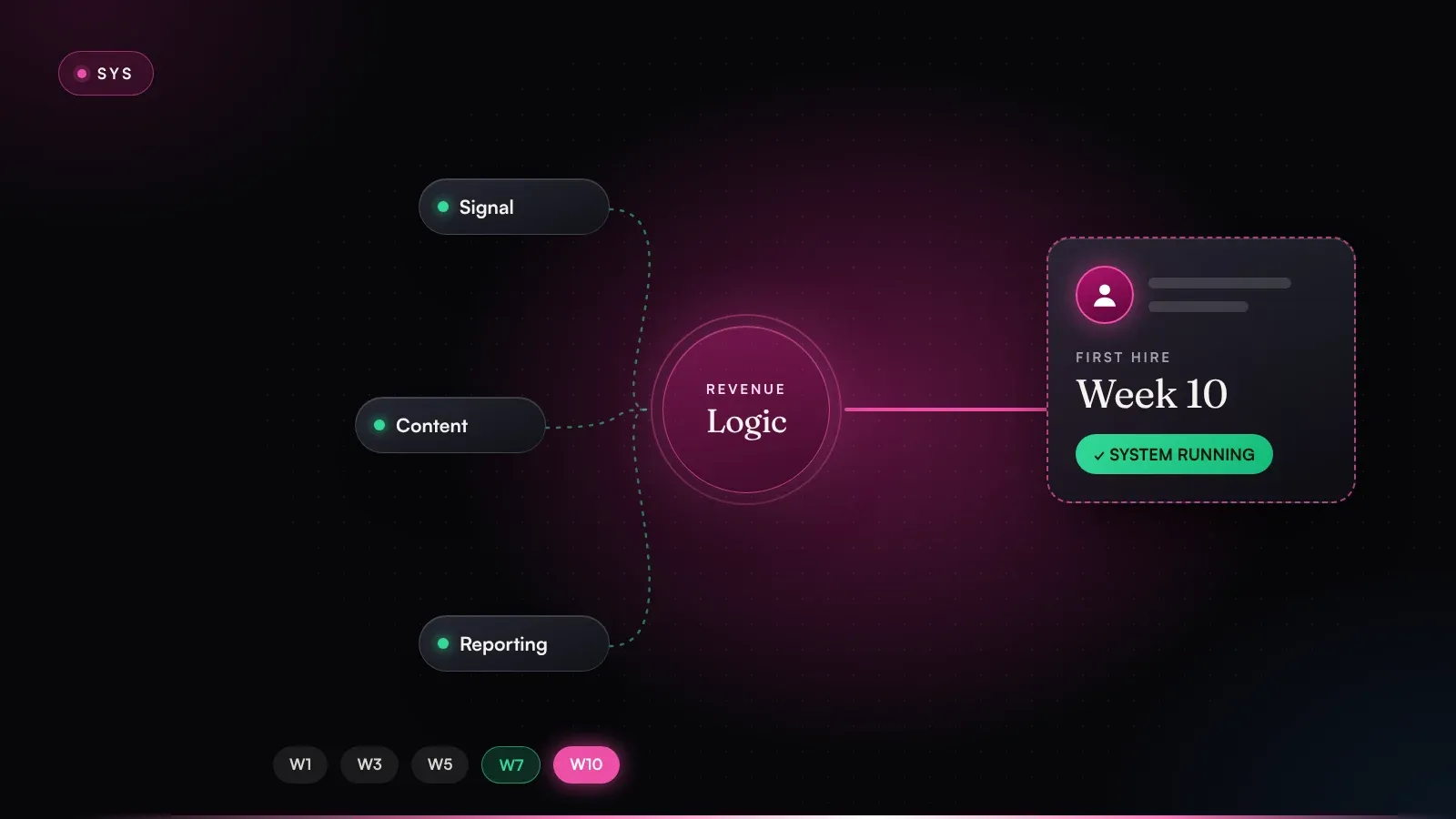
Its strength is recurring work at high frequency: research, monitoring, reporting, drafts and data upkeep. Agents need written revenue logic, usable data and someone who approves their proposals. They don't handle relationships or lead people, and the first ones usually go live from week 5.
Seven criteria for the decision
I use these criteria myself with founders, and they work for all four options.
- Maturity of your revenue logic. Check whether you can write down your ICP with exclusion criteria, your buying center and an angle per role. If not, every option starts by buying clarity.
- Type of gap. Name what's missing, whether that's judgment and leadership, execution in one channel, recurring systems work or closeness to the market. Each option is built for a different gap.
- Time to impact. Set the date by which you need the first measurable pipeline. An agency can often produce within weeks, while a hire usually takes months.
- Where the knowledge lives afterwards. Find out what will be documented in your systems when the engagement ends or someone resigns.
- Cost model and commitment. Retainer, day rate, salary or engagement plus tool costs carry different risks at the same total.
- Your management load. An agency needs briefs, a fractional CMO your decisions, a hire leadership and an agent system approvals. My design target is a single-digit number of go decisions per person per day.
- Fit with your sales motion. With a high ACV and long cycles, relevance per account matters most. For self-serve at a low ACV my advice only partly applies.
Agency vs. fractional CMO vs. in-house team vs. agent system
The table shows typical patterns from my work, and providers differ. Timings are my estimates, and the agent system figures come from my projects.
| Criterion | Agency | Fractional CMO | In-house team | Agent system |
|---|---|---|---|---|
| What you buy | Output in defined channels | Part-time senior judgment and leadership | Lasting capacity with context | Revenue logic, agents, governance and cadence |
| Main strength | Specialist depth and production capacity | Priorities, hiring, board | Closeness to sales and customers | Recurring work at high frequency |
| Usual limit | Depends on the brief, pipeline rarely in scope | Little time per week, depends on one person | Long search, risk of a wrong hire | Needs logic, data and an owner |
| First impact | Weeks after onboarding | First decisions within weeks | Months after the search starts | First agents from week 5, cadence after 30 to 90 days |
| Knowledge afterwards | Deliverables with you, methods often with the agency | With the person unless documented | With the people on your team | In the knowledge base and change log, in your accounts |
| Cost model | Retainer or project | Day rate or monthly fee | Salary, overheads, recruiting | Engagement plus tool and model costs |
| What you need internally | Someone who briefs and measures on pipeline | Your time for decisions | Leadership and onboarding | An owner and time for approvals |
| Best fit | Specialist channels with a clear strategy | Unclear priorities, first hires | Relationship work, daily coordination | Sales-led, high ACV, lots of routine |
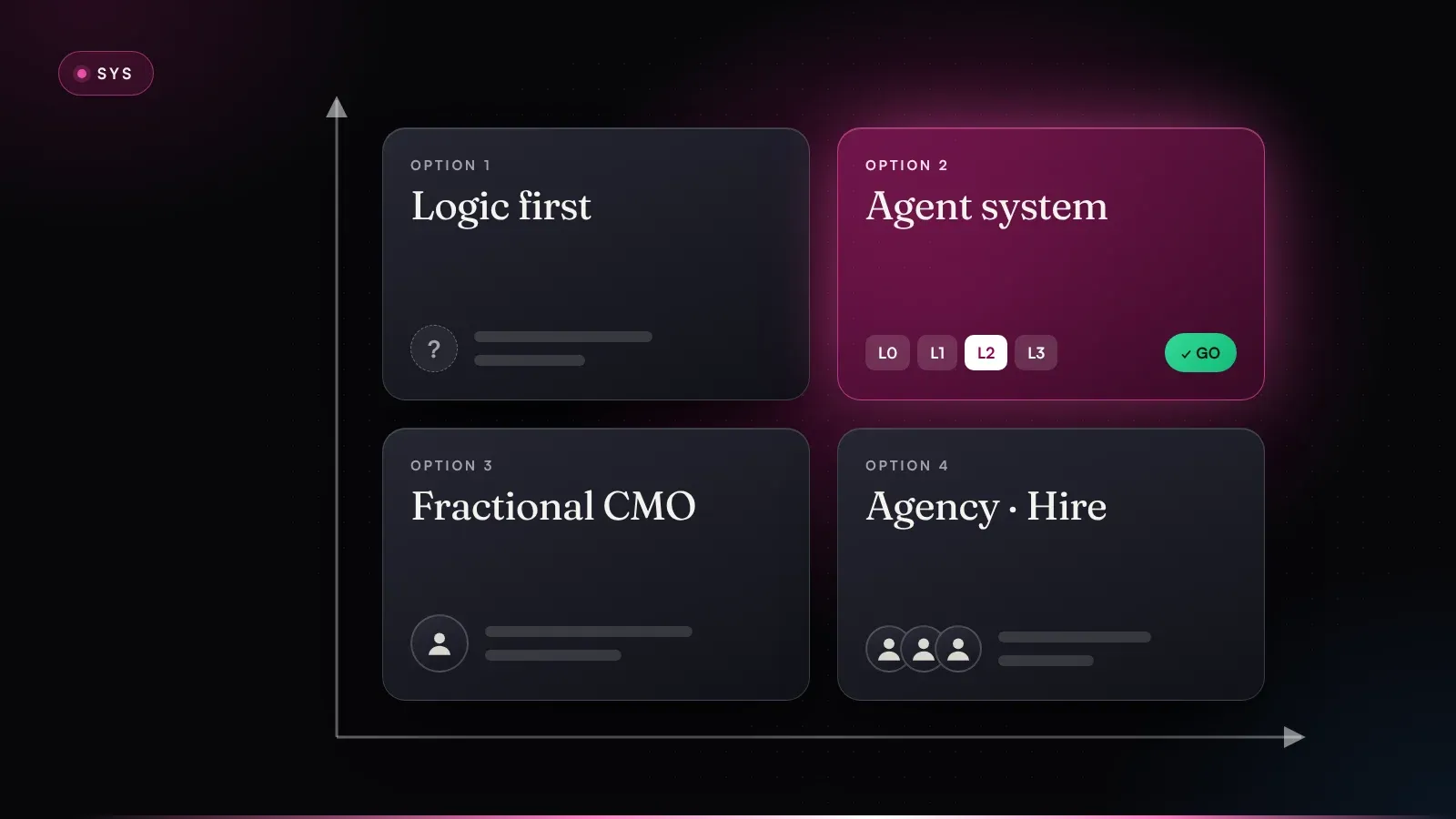
Two axes sort the options: how much of your revenue logic is written down and how much of the work repeats every week.
The further you sit to the top right, the more systems work pays off. Bottom left, you first need an experienced person to bring clarity.
When each option fits
Each option has situations where I'd recommend it without hesitation.
- Agency, once your revenue logic is in place and you lack execution in a well-defined channel, with someone on your side who holds the agency to pipeline.
- Fractional CMO, when what's missing is senior judgment, for instance on positioning or the order of your first hires, and a full-time executive would come too early.
- In-house team, when the logic is in place and there's enough work for full roles that depends on daily coordination with sales or on relationships.
- Agent system, when you sell sales-led at a five-figure ACV, much of the work repeats and output should grow faster than headcount. You also need to be willing to connect agents to CRM and ads under clear governance.
Mixed setups often work best. A fractional CMO sets priorities while an agent system handles the recurring work. Or you build the system before your first full-time hire starts, so that person walks into a cadence that already runs. I cover when a dedicated systems role makes sense in my piece on GTM engineering.
| Starting point | My recommendation | Why |
|---|---|---|
| ICP and angles live in your head | Diagnosis and revenue logic first | Every option needs this as input |
| Unclear priorities, the board wants a plan | Fractional CMO, documenting in your systems | You need judgment, and the knowledge should stay |
| Logic in place, one channel lacks execution | Agency for that channel | Specialist depth for a while, measured on pipeline |
| Logic in place, lots of recurring work, small team | Agent system with an internal owner | Your team gets time back for judgment and relationships |
| First hire planned, the role is still fuzzy | System first, then a targeted hire | The hire takes a clear job in a running system |
| Lots of activity, little pipeline | Reconnect the setup to pipeline first | More capacity would amplify the problem |
My Build path covers the second-to-last row, Repair the last.
Cost logic: what you pay for with each option
I only use numbers I can source and calculate the rest with stated assumptions. My own engagement prices are intentionally not on the website, I share them in the diagnosis call.
| Option | What you pay for | What drives the cost |
|---|---|---|
| Agency | Hours or output per month | Scope, number of channels, seniority on the team |
| Fractional CMO | Days per week or month | Day rate and duration |
| In-house team | Salary, overheads, recruiting, onboarding | Seniority, length of the search, wrong hires |
| Agent system | Setup as an engagement, then models, data and tools | Number of agents and integrations, internal approval time |
Fractional CMO: one number with a source
For interim roles in Germany there's one figure I'd rely on. The DDIM market study 2026 projects an average day rate of €1,317 for interim managers in 2026. It covers all functions in the German market, and I haven't found a marketing-only figure. I also haven't found a comparable source for Austria or Switzerland.
Assumed day rate:  €1,317 net (DDIM market study 2026, forecast, all functions)
Assumed scope:     2 days a week, about 8.7 days a month (2 × 52 ÷ 12)
Per month:         about €11,400 net
Over 12 months:    about €137,000 net
Not included:      execution by a team or agency, tools, media budget
Plug in your own values.
Agency, in-house team and agent system
I haven't found a citable source for agency retainers in DACH. Ask each proposal how many hours at which seniority the retainer covers.
For the first hire I have one number from my projects. At an LLM observability company with about €1.5M ARR, getting the first marketing hire wrong would have cost around €120,000 fully loaded, plus twelve months of runway. It's one case, though it shows the size of the risk.
With an agent system you pay for the setup, which at RevPrime® is a clearly scoped engagement with no open-ended retainer. Running costs for models, enrichment and tools go through your own accounts with no markup. The cost people forget is internal time.
Of a 400-hour week for a ten-role team, 77 hours stay with people, almost half of it for judgment, priorities and relationships.
My guide Two people. The workload of ten. works this through for a ten-role team with 400 hours a week. By type of work, the model leaves 77 hours with people, about 1.9 FTE, or up to 113 hours (2.8 FTE) if the assumptions break. The role mix and shares are my assumptions and weren't measured. At €3M in revenue you probably don't have a team of ten, yet the method carries over. Count your hours by type of work, and the judgment column tells you how many people you need.
When RevPrime® is the wrong choice
Here are the cases where I'd steer you away from my own offer:
- You sell self-serve or product-led at a low ACV, where activation in the product matters more than account signals.
- You're B2C or pre-revenue. Without customers there's no revenue logic for agents to work from.
- You mainly want more content. I don't build content factories.
- You're looking for a classic fractional CMO who manages the team and does the hiring. I don't take on that role.
- Nobody on your team can own the system and approve proposals, so it would stall after handover.
- You don't want agents connected to your CRM and ad accounts, even with a permission ladder and a change log.
- You want a pure performance agency that runs individual campaigns.
If one of these applies, I'll say so in the diagnosis call. The revenue due diligence ends with one of three answers, go, not yet or no fit, and the analysis is yours either way.
Example: before the first marketing hire at about €1.5M ARR
One of my anonymized case studies shows the trade-off. An LLM observability company with about €1.5M ARR had eleven paying customers, all won by the founder through network and conferences. Pipeline had been flat for two months, warm intros were running out, and the Series A conversation needed pipeline beyond the founder's contacts. The first marketing hire was already planned.
Before anyone was hired, I built a 90-day revenue marketing blueprint and rewrote the job profile. Revenue logic and knowledge base came first, then hub and agents. The first marketing-sourced SQLs arrived in week 7, before the new hire had started. Q1 pipeline came in at 124% of plan, and the founder got about 12 hours a week back.
- Weeks 1–2Revenue logicKnowledge base with owners
- Weeks 3–4Hub connectedApprovals and dashboards
- From week 5First agentsLaunch after a go
- ThenFirst hireA clear job in a running system
The sequence from the example. Revenue logic, hub and first agents are in place before the new hire starts.
My estimate for the other options: an agency would have needed a brief that didn't exist yet, and a good fractional CMO would likely have sharpened the job profile too, though the recurring work would have stayed with the founder.
Common mistakes when founders decide
- Choosing the option before the diagnosis. Without a named gap, every option is a bet.
- Comparing a day rate with a salary. A fair twelve-month view includes overheads, search time, onboarding and commitment.
- Loading everything onto the first hire. Strategy, campaigns, website, reporting and CRM upkeep in one person end in compromises.
- Putting agents on top of unclear logic. Agents amplify what's already there, clarity and chaos alike. Without exclusion criteria, an agent researches diligently in the wrong direction.
- Leaving ownership open. Agree upfront which accounts the work lives in and what gets handed over.
Making the call in 30 days
Four weeks are enough.
- Week 1: write down your revenue logic. ICP with exclusion criteria, buying center, one angle per segment and role. The agentic readiness check shows your biggest gaps in minutes.
- Week 2: inventory the work by type. Count weekly hours for analysis, production, routine, coordination and judgment.
- Week 3: test the options against the criteria. Talk to two providers per option and ask each what stays in your systems afterwards.
- Week 4: decide and write it down. Draft a short decision note and put the 90-day review in the calendar.
Gap:                  one sentence (judgment, channel execution, routine or market closeness)
Revenue logic:        written down yes/no, owner: …
Chosen option:        …, combined with: …
Success after 90 days: pipeline metric, target, checkpoint in the weekly
What stays in-house:  accounts, documentation, access
Internal time:        who briefs or approves, hours per week
Review date:          date
If the first line won't fit in one sentence, go back to week 1.
My recommendation
If your revenue logic isn't written down, hold off on buying capacity. Put the money into clarity first, with a fractional CMO or a structured diagnosis.
If the logic is in place and the gap is mostly recurring work, build a system with an internal owner, then hire for judgment. If you lack leadership, bring in a fractional CMO and agree that decisions get documented in your systems. If you lack depth in one channel, hire an agency and measure it on pipeline.
For a second opinion on where you stand, book a free 30-minute diagnosis call with me. You'll get a clear recommendation, even if it isn't RevPrime®. How I work and who I work with is on the customer overview page.
Frequently asked questions
What's the difference between an agency and a fractional CMO?
An agency produces output in defined channels such as paid media or content, usually on a retainer. A fractional CMO is a part-time senior leader who sets priorities, allocates budget, guides hiring and leads the team, while others carry out the work.
How much does a fractional CMO cost in Germany?
The DDIM market study 2026 projects an average day rate of €1,317 for interim managers in Germany across all functions. Figures for marketing roles alone are rare. At two days a week that works out to about €11,400 net per month, before execution and tools.
When should a B2B SaaS company make its first marketing hire?
Once your revenue logic is written down and there's enough work that needs judgment or daily coordination with sales. Before that, the first hire has to build the logic while delivering. In one of my projects, a wrong first hire would have cost around €120,000 fully loaded.
Can an AI agent system replace a marketing team?
It takes over recurring work such as research, reporting, monitoring and drafts, with a human go before anything with external effect. Positioning, budget, relationships and team leadership stay with people. In my model calculation, 77 of 400 weekly team hours stay with people.
Can I combine a fractional CMO with an agent system?
Yes, and it often works well. The fractional CMO sets priorities and makes the calls, while the agent system does the recurring work and logs every approval, so the knowledge stays in your systems.
Who is RevPrime® not a good fit for?
Self-serve or PLG companies with a low ACV, B2C and pre-revenue companies, buyers who mainly want content production, and anyone looking for a classic fractional CMO who manages a team. It also won't work if nobody on your team can own the system.

About the author
Mario Maier
AI-native revenue marketing engineer · founder of igromo
For more than 15 years I've worked at the intersection of marketing, sales and revenue operations, from early-stage setups to scale-ups with multi-stage sales cycles and large buying centers. Since 2019 I've measured my work on pipeline and revenue.
Where do you stand?
The agentic readiness check shows in 3 minutes how ready your marketing is for agents – and which gaps to close first.
Keep reading
All insightsSYS24 min read
AI agents for B2B marketing: the complete guide from first prompt to pipeline
AI agents for B2B marketing that move pipeline: definition, architecture, 8 core agents with workflows, what not to automate, KPIs and a 90-day plan.
SYS12 min read
Your first marketing hire after founder-led sales: who to hire and what to build first
Your first marketing hire after founder-led sales: which profile fits, what to build before the job ad and how to judge the hire after 90 days. With a case.
SYS12 min read
How to audit a B2B SaaS marketing funnel in three weeks: a week-by-week guide
A marketing funnel audit for B2B SaaS, week by week: the data and questions I use and how I rank findings by impact and effort. With checklists.