How to audit a B2B SaaS marketing funnel in three weeks: a week-by-week guide
Plenty of B2B SaaS teams ship campaigns every week and still miss their pipeline number, and by the end of the quarter everyone has a favourite explanation. A marketing funnel audit tests those explanations against what your systems record and what the people closest to revenue tell you. Here is how I run one in three weeks: the data and questions for each week, and how a long list of findings becomes a short plan.
 ByMario Maier
Published 12 min read
Contents
- Why the audit comes before the next campaign
- The six areas of a B2B SaaS funnel audit
- Before week 1: access, definitions and one contact
- Week 1: kickoff and a first pass at the numbers
- Week 2: reading the systems stage by stage
- Weeks 2 and 3: five workshops, one role each
- Week 3: ranking findings by impact and effort
- What you walk away with
- Where agents help during the audit, and where people decide
- Common mistakes in a marketing funnel audit
- Running the audit yourself
Why the audit comes before the next campaign
The situation usually looks like this. Marketing ships campaigns every week, and the quarterly review still shows a pipeline gap. Marketing points to lead volume, sales to lead quality. As a founder or revenue leader, you're left wondering what the budget is buying. Each team has a theory about the leak. Very few of those theories come with evidence.
The usual responses are familiar too: more campaigns, an agency for one channel, another hire, a rebuilt dashboard, one more AI subscription. Any of them might be the right call. Which one becomes clear once you know where pipeline actually gets lost.
AI raises the stakes. Agents amplify whatever is already in place, mess included. Automate a fuzzy ICP or a half-maintained CRM and you get the same errors faster. So I start every engagement with a funnel audit, which at igromo is called the Revenue Due Diligence. Most of the method works without me.
Theories in the team
- “The leads are bad”
- “Sales follows up too late”
- “More budget will fix it”
- “The tool is the problem”
Findings from the audit
- Conversion per stage from the CRM
- Causes from five workshops
- Ranked by impact and effort
- An order with owners
An audit checks every theory against system data and against what each team reports.
Who this is for
I built the method for sales-led B2B SaaS and AI companies with €1M to €25M in revenue, five-figure contract values and sales cycles measured in months. Either there's a marketing team with budget whose pipeline contribution nobody can show clearly, or marketing is about to be built and you want to know what the first hire and first agents should stand on. Self-serve businesses with a low ACV are a weaker fit.
The six areas of a B2B SaaS funnel audit
Conversion rates show where the funnel leaks. To find out why, I look at six areas, the same six that make up the maturity analysis in the Revenue Due Diligence.
| Area | What I check | Main data source | Opening question |
|---|---|---|---|
| Revenue logic & ICP | ICP with exclusion criteria, buying center, message angles, priorities; written down or held in people's heads | Positioning and sales documents, founder and leadership workshop | Could anyone on the team say in two sentences which accounts fit and which don't? |
| Data & systems | Fill rates of key CRM fields, ownership, tool stack, integrations, workflows | CRM, marketing automation, RevOps workshop | Which fields would you trust enough to base a budget decision on them? |
| Funnel performance | Conversion and time in stage, drop-off, speed | CRM deals and stages, lead status in marketing automation | At which stage do the most good-fit accounts fall out? |
| Marketing and sales alignment | MQL to SQL handover, shared definitions, feedback from sales to marketing | Marketing and sales workshops, lead status history | What happens in the first days after a handover, and who decides? |
| Pipeline accountability | What gets measured, attribution, what decisions rest on | Reporting, ad accounts, web analytics | Which marketing metric triggered a budget decision last quarter? |
| AI-native maturity | How the team uses AI, which tools, measurable effect, permissions and approvals | Marketing workshop, tool inventory, permissions in CRM and ad accounts | Who can change things in the CRM and ad accounts today, and where is that logged? |
Revenue logic comes first because everything else gets measured against it. If nobody has pinned down which accounts fit, there's no way to tell whether a dropped lead was a loss at all. Drop-off among poor-fit companies is healthy and doesn't belong on the findings list.
- Before week 1Access & definitionsSlots, one contact
- Week 1Kickoff & first countTarget, segments, data gaps
- Week 2Reading the systemsConversion and speed per stage
- Weeks 2–3Five workshopsOne role each, remote
- End of week 3Synthesis & readoutMaturity, roadmap, go or not
The order is fixed. Read-only access from start to finish, nothing in your systems changes.
Before week 1: access, definitions and one contact
Audits tend to stall before day one, on a missing ad account login or a workshop slot three weeks out. So I sort these things first.
Pre-kickoff checklist
- Read-only access to CRM, marketing automation, ad accounts and web analytics, set up together with your admin
- Five workshop slots of about 90 minutes each, remote by video call
- One point of contact who can open doors and answer quick questions
- A readout of about two hours with leadership at the end of week 3
- Whatever exists on ICP, positioning, sales process and targets, in its current state
- The MQL, SQL and opportunity definitions in use today, even if they've never been written down
That last item often reveals the most. When marketing and sales mean different things by “MQL”, each team measures a different funnel. I write the definitions down at the start, including when a deal counts as lost and how “no decision” is handled. My article on sales velocity as a marketing KPI shows how much a single definition can move a number.
As a time window I usually take the last four quarters. That's long enough to spot seasonal swings and recent enough that the processes behind the data haven't changed.
Week 1: kickoff and a first pass at the numbers
The kickoff sets the yardstick: the pipeline target for the next twelve months and the share marketing is expected to contribute. I also agree which segments get looked at separately. Without those numbers I can't tell later whether a leak is big or small.
Then I set up access and do a rough first count of every deal from the last four quarters by stage and segment. It tells me where to dig in week 2 and surfaces the first data gaps. Gaps go on their own list. A missing field is a finding.
Data sources and what I look at first
| System | First things I look at |
|---|---|
| CRM | Deals and stages, create and close dates, lost reasons, contacts per deal, ownership |
| Marketing automation | Lead status, scoring rules, active workflows, handover to sales, nurture |
| Ad accounts | Spend, audiences, conversions, and how much of it reaches pipeline |
| Web analytics | Traffic quality, visits from target accounts, conversion paths |
| Reporting | Which reports exist, who reads them, which decisions follow |
| AI tools | What's in use, by whom, and whether any effect is measurable |
Questions I ask in week 1
- What's the pipeline target for the next twelve months, and how much of it should marketing source?
- Who owns the CRM, marketing automation and ad accounts?
- Which MQL, SQL and opportunity definitions apply, and since when?
- Where are ICP, buying center and messaging written down today?
By the end of week 1, access works, definitions are documented, there's a first funnel count and a list of data gaps.
Week 2: reading the systems stage by stage
Week 2 happens almost entirely inside your tools. I calculate the funnel from engaged accounts to closed won, split by segment, and look for the stage where most good-fit accounts disappear. Slide decks wait until the workshops.
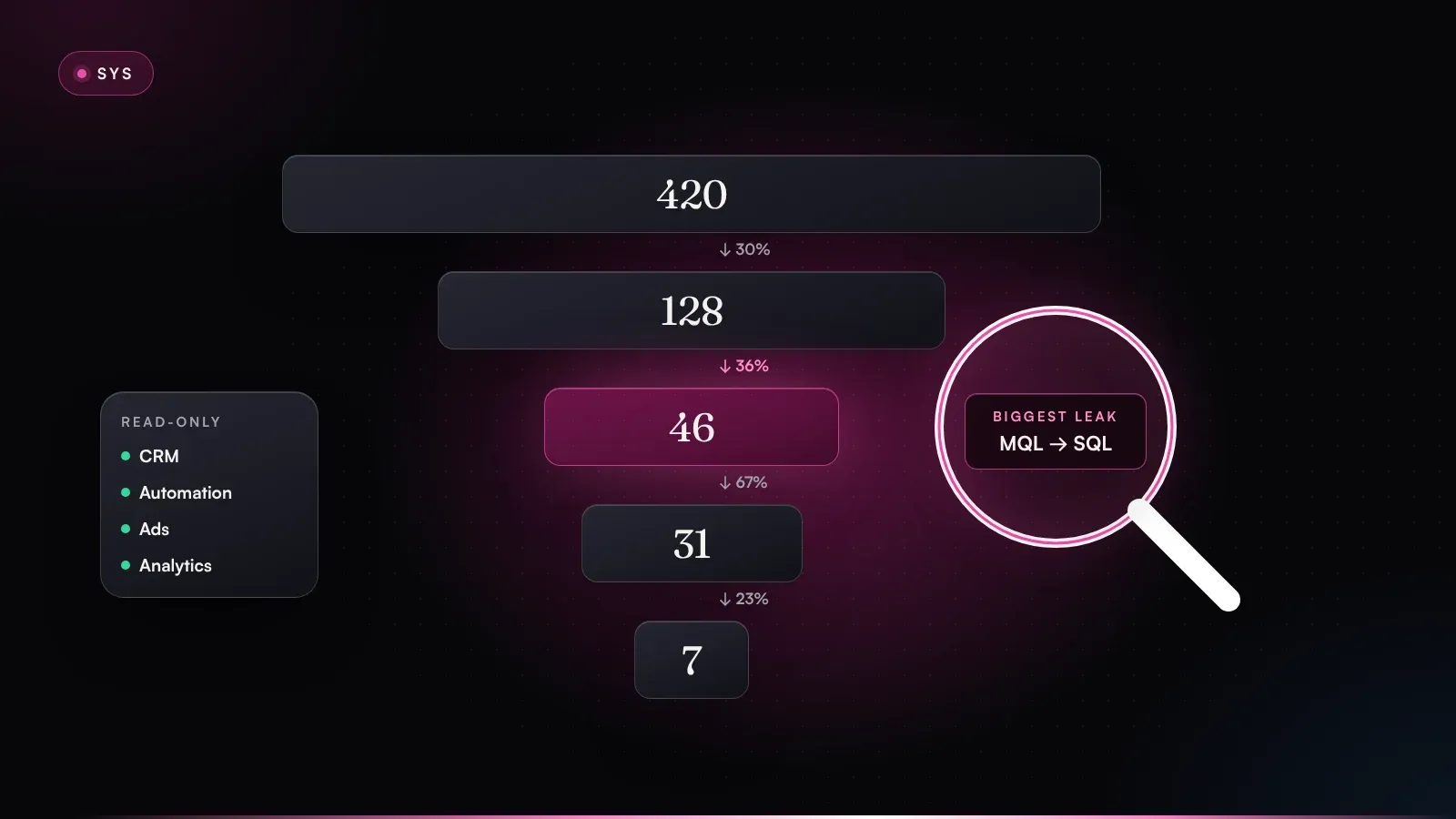
What matters is the stage that loses the most relative to the target. Here it's the step from MQL to SQL.
Data quality comes first
Before I interpret any conversion rate, I check whether the data underneath holds up. I look at whether industry, company size, segment and source are filled in, whether opportunities are attached to a company and the right contacts, whether close dates are set automatically, and whether anyone can still explain the active workflows. That decides which analyses I trust later.
Conversion and speed per stage
Next come conversion and time in stage per segment. I watch the gap between handover and first sales activity closely, since interest cools fast there, along with the share of deals that end without a decision.
Paid media, website and attribution
In the ad accounts I follow spend into the pipeline and separate good-fit contacts from conversions that never reach sales. On the website I look at visits from target accounts and the paths to an inquiry.
Week 2 checklist
- Fill rates of ICP fields on accounts and deals checked
- Conversion and time in stage calculated per segment
- Time from handover to first sales activity measured, where the data allows
- Share of “no decision” outcomes and quality of lost reasons reviewed
- Active workflows, scoring rules and reports in actual use listed
Questions I ask in week 2
- How many opportunities from the last four quarters came from accounts that match the ICP?
- How long does a handed-over lead wait for its first contact from sales?
- For how many lost deals does the lost reason actually say something?
- How much ad spend reaches accounts that never show up in pipeline?
If scoring itself looks off, the logic behind it deserves a closer look. I describe a model built on fit, intent and timing that sales can trust in Fit × intent × timing: an account scoring model sales actually trusts.
Weeks 2 and 3: five workshops, one role each
Alongside the system work I run five workshops: marketing, sales, customer success, RevOps and founders or leadership. Each takes about 90 minutes over video. Questions go out ahead of time, so nobody builds slides.
I keep the sessions separate so each role can speak without the others in the room. Each sees a different slice of the funnel, and the picture comes together once all five sit side by side.
| Workshop | Focus | Sample question |
|---|---|---|
| Marketing | Channels, content, campaigns; MQL to SQL handover; how the team uses AI today | If you had half the time, which activity would you drop first? |
| Sales | Pipeline quality and sales cycle; win and loss reasons; what sales needs from marketing | How early in a first call can you tell a deal won't happen? |
| Customer success | Expansion and churn signals; references and case studies; voice of the customer | Which customers would buy again today, and what do they share? |
| Revenue operations | CRM data and attribution; reporting and KPIs; tools and automation | Which CRM workflow worries you most? |
| Founder & leadership | Goals and priorities; ICP and positioning; budget and the next 12 months | Which customers do you deliberately want to stop winning a year from now? |
I learn most where statements and data disagree. If marketing describes same-day handovers and the CRM shows something else, that's a finding. Same when sales names price as the main reason for lost deals and the lost-reason field is empty. I log each contradiction with its source, and in the synthesis they often decide which finding moves up.
Week 3: ranking findings by impact and effort
Two weeks in, the list of findings is long. Tackle all of them at once and none gets far, so the synthesis in week 3 matters most.
One profile per finding
Before ranking anything I write up every finding in the same format. That way an empty field group in the CRM and a campaign with no pipeline effect become comparable.
| Field | Content |
|---|---|
| Finding | What stands out, in one sentence |
| Evidence | A number from the system or a statement from a workshop, with source |
| Stage affected | Where in the funnel it bites |
| Impact | Rough estimate of how much fixing it could move pipeline |
| Effort | What the fix costs in time and coordination |
| Dependencies | What needs to be in place first |
| Proposed owner | Who should own it, a person or later an agent |
Filled in, a profile looks like this. The example is fictional and matches the funnel in figure 3:
Finding:          Handed-over MQLs wait a median of three days for the first sales touch
Evidence:         CRM, handover and first-activity timestamps, last four quarters
                  Marketing workshop: “same-day handover”
Stage:            MQL → SQL, 36% conversion
Impact:           high, affects every inbound lead in the ICP
Effort:           low, a routing rule and a response target in the CRM
Dependencies:     shared MQL definition, an owner per segment
Proposed owner:   RevOps, later an agent on an approved rule
The impact and effort matrix
Then each finding goes into a matrix with expected pipeline impact on one axis and effort on the other. High impact at low effort lands in the quick-win corner. Low impact at high effort moves to the back, however much the team happens to be debating it.
Example as on the Revenue Due Diligence page. The few findings that move a lot of pipeline at reasonable effort go first.
Four rules for the order
A matrix can't show dependencies, so I apply four rules on top.
- Foundation first. Revenue logic and data come before everything else. Scoring built on empty fields won't hold. Agents join once both are in place.
- Bottleneck before polish. The stage with the largest loss relative to target goes first, because one weak factor eats the gains made everywhere else.
- Few fields of action at once. At the start, only as many as your team can carry next to the day job.
- Every finding has an owner. Anything nobody owns will be back on the list next quarter.
The self-check in my guide “Two people. The workload of ten.” offers a shortcut for rule one. Zero points on CRM reliability, marketing rhythm or permissions and approvals means you start there, whatever your total score.
What you walk away with
At the readout at the end of week 3, about two hours with your leadership team, I present two deliverables.
The first is the maturity analysis. It scores the six areas and shows the funnel problems with numbers from your own systems. From there it spells out what marketing needs to change to have a bigger effect on pipeline and revenue. It ends with prioritized fields of action, quick wins first.
The second is the roadmap. It covers how the system plugs into your stack and team, the two or three agents with the biggest lever and why those, what goes live when, which tools to add or drop, and how much time your people need to set aside.
You also get a straight answer: go, not yet, or no fit. Go means the basics are there and the first agents can start. Not yet means revenue logic, data or ownership need work first, and you get the order to tackle them in. No fit means my method doesn't suit your sales motion. In every case, the analysis is yours.
Where agents help during the audit, and where people decide
I use agents in the audit as well. They read your systems and help me map pipeline and ownership within days. Counting and cross-checking between systems are jobs they do quickly and thoroughly.
Their permissions stop at reading. No agent writes anything into your systems during the audit, and I don't either. The security & governance pack explains how permission levels work once agents are running.
The workshops and the ranking stay with people. Whether a finding matters depends on your goals and budget. I work through that trade-off with you, and the decision is yours.
Common mistakes in a marketing funnel audit
- Stopping at the handover to sales. Deals also get lost between SQL and close, and marketing can help there, for example with material for other roles in the buying committee.
- Averaging across segments. A handful of large enterprise deals skews conversion and cycle length enough to hide mid-market problems.
- Estimating away data gaps. A roadmap built on an estimate inherits the estimate.
- Putting every role in one workshop. The loudest view tends to win, and the contradictions you're looking for stay hidden.
- Starting with tools. Asking which tool is missing makes it easy to overlook the missing rules the tool would need.
Running the audit yourself
You can do a lot of this with your own team if someone with RevOps experience has the time. The workshops are the hard part. When you're part of the system, some questions don't get asked, and some answers change in front of colleagues.
For a quick first read before planning anything, answer the eight questions in the agentic readiness check. It takes three minutes and shows where your biggest gaps are.
If you'd like to run the audit with me, it starts with a 30-minute diagnosis call. I look at where things get stuck and whether a Revenue Due Diligence makes sense for you, and if it does, I go through scope and investment with you. Afterwards you decide whether to continue with Build or Repair, with your own team, or not at all.
Frequently asked questions
What is a marketing funnel audit?
A marketing funnel audit identifies where good-fit accounts and deals drop out between first touch and closed won, and why. It combines system data with input from every team that touches revenue. The output is a ranked list of findings with a clear order of work.
How long does a B2B SaaS funnel audit take?
About three weeks in the version described here, with the readout at the end of week 3. Your team mainly commits five workshops of about 90 minutes and a readout of about two hours.
What data do I need for a funnel audit?
At minimum: deals with stages, create and close dates, value and status from the CRM; lead status and handovers from marketing automation; spend and conversions from your ad accounts; and visitor data from web analytics. The last four quarters make a good window. Missing data is itself a finding and gets documented.
What is a Revenue Due Diligence?
The Revenue Due Diligence is my format for a funnel audit. It takes about three weeks, works with read-only access to your core systems, includes five workshops and delivers a maturity analysis across six dimensions plus a roadmap for the first agents. The scope is fixed, there's no lock-in, and the results belong to you.
How do I prioritize findings from a funnel audit?
Describe each finding with its evidence, affected stage, impact, effort, dependencies and owner, then place it on an impact and effort matrix. On top of that I use four rules: revenue logic and data first, the biggest bottleneck before fine-tuning, few fields of action at once, and no finding without an owner.
Does a funnel audit change anything in my systems?
Not when I run it. I work with read-only access only, and the agents that help with the analysis can only read as well. Changes come later, and only after you approve them.

About the author
Mario Maier
AI-native revenue marketing engineer · founder of igromo
For more than 15 years I've worked at the intersection of marketing, sales and revenue operations, from early-stage setups to scale-ups with multi-stage sales cycles and large buying centers. Since 2019 I've measured my work on pipeline and revenue.
Where do you stand?
The agentic readiness check shows in 3 minutes how ready your marketing is for agents – and which gaps to close first.
Keep reading
All insightsSYS24 min read
AI agents for B2B marketing: the complete guide from first prompt to pipeline
AI agents for B2B marketing that move pipeline: definition, architecture, 8 core agents with workflows, what not to automate, KPIs and a 90-day plan.
SYS12 min read
Your first marketing hire after founder-led sales: who to hire and what to build first
Your first marketing hire after founder-led sales: which profile fits, what to build before the job ad and how to judge the hire after 90 days. With a case.
SYS12 min read
Agency, fractional CMO, in-house team or agent system: how B2B SaaS founders decide
Fractional CMO vs agency, in-house team or AI agents: seven criteria, a comparison and the cost logic for SaaS founders, plus when RevPrime® isn't a fit.