Your first marketing hire after founder-led sales: who to hire and what to build first
Most B2B SaaS and AI founders make their first marketing hire right after founder-led sales stops carrying the pipeline. Before the job ad, I look at what has to exist so that a new person can turn marketing into pipeline. This piece covers which profile fits a sales-led company with €1M to €25M in revenue, what to build before the ad goes out, and how to judge the hire after 90 days.
 ByMario Maier
Published 12 min read
Contents
- When founder-led sales stops carrying the pipeline
- What a wrong first marketing hire costs
- Who should your first marketing hire be?
- What has to be in place before you write the job ad
- System first, hire second: the sequence I use
- Example: from eleven founder-led customers to a running system
- What the first hire owns, and what agents take over
- Mistakes I see founders make with the first marketing hire
- How to judge the first marketing hire after 90 days
- My take: when to bring me in
When founder-led sales stops carrying the pipeline
Founder-led sales works for longer than most people expect. The founder knows the product better than anyone, has the network and can answer the hard technical question in the first call. The first customers of a B2B SaaS or AI company often come in exactly this way, through intros and conferences.
Then the pattern changes, and the signs look similar from company to company. Warm intros run dry and pipeline stays flat for weeks. Soon the board or the next funding round asks how growth is supposed to happen without the founder sitting in every deal.
One of my Build clients is a clear example. An LLM observability company at about €1.5M ARR had eleven paying customers, all of them won by the founder through their own network and conversations at conferences. Pipeline had been flat for two months. The Series A conversation expected a system that could produce pipeline without the founder's contact list. The first marketing hire was already planned.
That's the moment the hire feels most urgent. It's also one of the decisions that's hardest to undo. In my guide Two people. The workload of ten. I put it like this: the hires you make this year shape your GTM for the next two.
What a wrong first marketing hire costs
In the case above, getting the first marketing hire wrong would have cost around €120k fully loaded, plus a year of runway. For a company preparing its Series A, the lost year is the expensive part. Onboarding and probation alone mean it usually takes months before a poor fit shows, and during those months the pipeline the next round depends on doesn't get built.
In the mis-hires I've seen at this stage, the cause usually sat in the role definition. The same causes come up again and again:
- The job ad goes out before anyone has decided in which order marketing should be built.
- The new person is expected to open new channels before there's a system to run them.
- Everyone uses AI in their own way, with their own prompts and no shared rules.
- The founder counts output, and the board asks about pipeline.
Behind most of these sits a reactive build-out. It starts with content, then comes a freelancer, then the first hire, then a second channel, and about a year later a reorg. Every step made sense at the time it was taken. Put together, they leave a team that ships plenty and has no shared logic for what any of it is for.
Reactive build-out
- Content
- A freelancer
- The first hire
- A new channel
- A reorg
System first
- Weeks 1–2: revenue logic
- Weeks 3–4: hub and data
- From week 5: first agents
- Then: the new hire joins
On the reactive path, each step takes three to six months and the whole path more like 12 to 24, with cost climbing at every step. Time ranges are typical values from my projects.
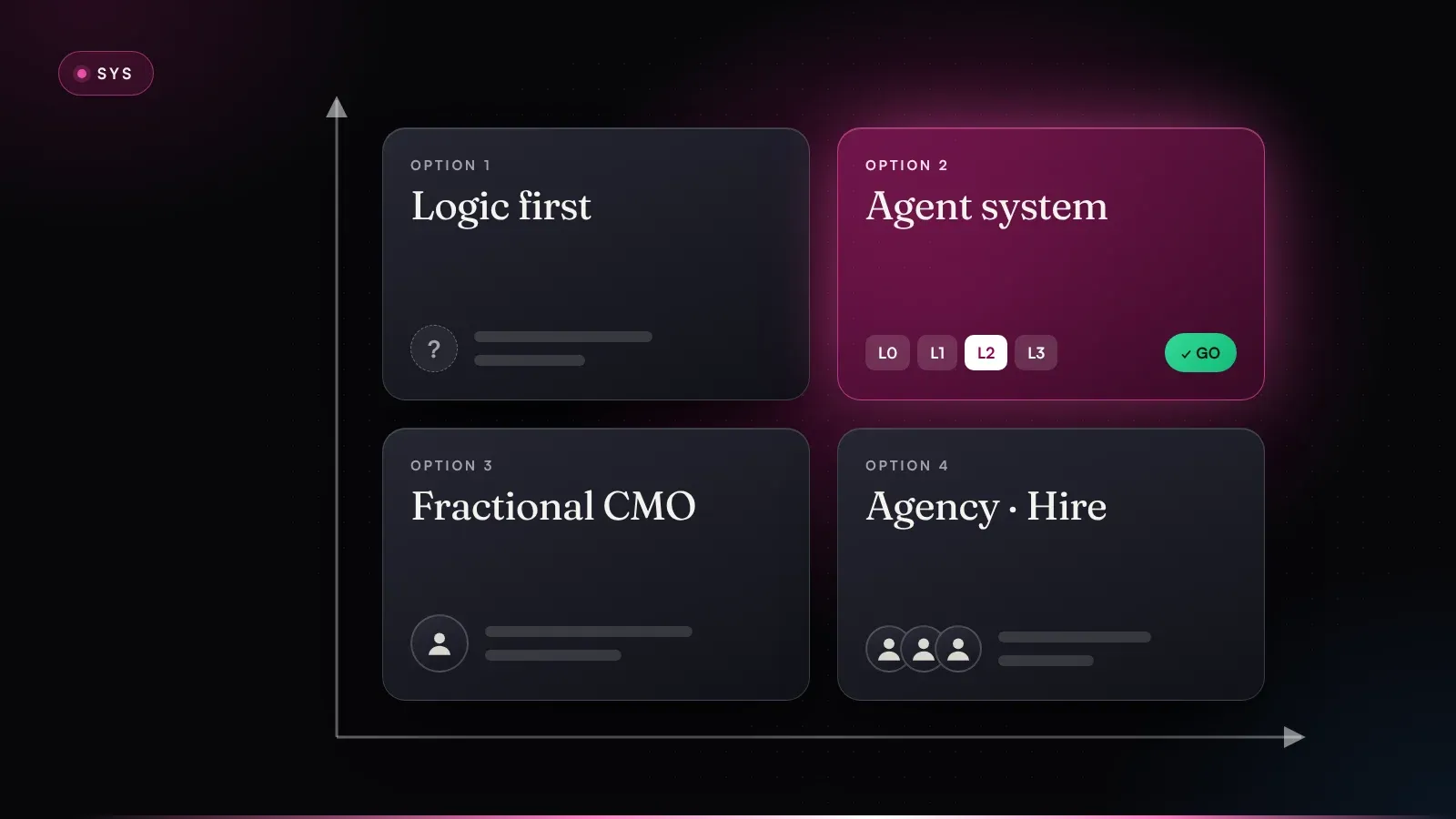
Who should your first marketing hire be?
Start with the question the person is supposed to answer. For a sales-led company leaving founder-led sales, that question is how marketing produces qualified pipeline in the ICP without the founder's network. Different profiles answer it with different starting conditions.
| Profile | Strong at | Needs on day one | Risk as the first hire |
|---|---|---|---|
| Head of marketing | Leading a team, budgets, agencies, brand | A team to lead and a strategy to execute | Spends the first months on structure and hiring while pipeline waits |
| Marketing manager (generalist) | Running campaigns, content, events | Priorities, ICP and messages someone else has defined | Produces volume against assumptions, output rises and pipeline stays flat |
| Revenue marketing lead | Owning pipeline with sales, ICP, angles, weekly review | CRM access, founder time, tools or agents for production | Slows down if the founder's knowledge never gets written down |
| GTM engineer | Data, routing, automation, agents | Documented revenue logic and enough systems work | Automates assumptions if the logic isn't there yet |
| Agency or freelancers | Capacity for single channels | A brief, priorities and someone who reviews | Knowledge stays outside, nobody owns the whole picture |
Table: my assessment from projects, not a study.
In the observability case, I rewrote the profile from “head of marketing” to “revenue marketing lead”. The new title attracts a different person. A head of marketing usually expects a team and a budget. A revenue marketing lead expects to work on pipeline targets with sales from week one, with the founder as the main source of knowledge.
The head of marketing profile has its place, too, once there's something to lead. In another engagement, a cybersecurity SaaS company at about €12M ARR, the VP of marketing had left and the new head of marketing started in week three. She needed an operating system she could lead from and hire against. She later hired two roles against a live operating rhythm. At that stage, the head of marketing profile was the right one.
My rule of thumb follows from both cases. If there's no system yet, there's also nothing for a team lead to lead, so hire the person who builds and owns pipeline. If a system and a few people are in place, a head of marketing has something to lead. If you're mostly missing systems work, read my article on GTM engineering before you post the ad.
What has to be in place before you write the job ad
The takeaway on page 2 of my guide is short: write down your ICP, buying center and angles before you write the job ad. The new hire then walks into a system that already runs.
The reason is timing. At around €2M ARR, what a company knows about its ICP and its buying center still lives in a handful of heads. Getting it into a knowledge base with clear owners takes weeks. At twelve people and fourteen programs, the same work turns into a change project, politics included.
Before the ad goes out, go through this list honestly:
- Your ICP, including exclusion criteria, is written down somewhere outside the founder's head.
- The buying center of your typical deals is documented, with the roles involved and the proof each of them needs.
- There's at least one message angle per segment and role, with a status showing whether it has been tested.
- Deals and stages in the CRM are reliable enough to report pipeline from.
- Marketing and sales meet weekly with numbers, or you know who will run that meeting.
- It's clear who can change things in the CRM and the ad accounts, and changes get logged.
- You know how you'll judge the hire after 90 days, and the answer is pipeline.
The self-check in my guide has eight questions. Three of them carry special weight here: CRM reliability, marketing rhythm and who can change what. If any of these scores zero, start there, even if the total looks good. Agents and new people both scale exactly that gap. The online version is the agentic readiness check, eight questions in about three minutes.
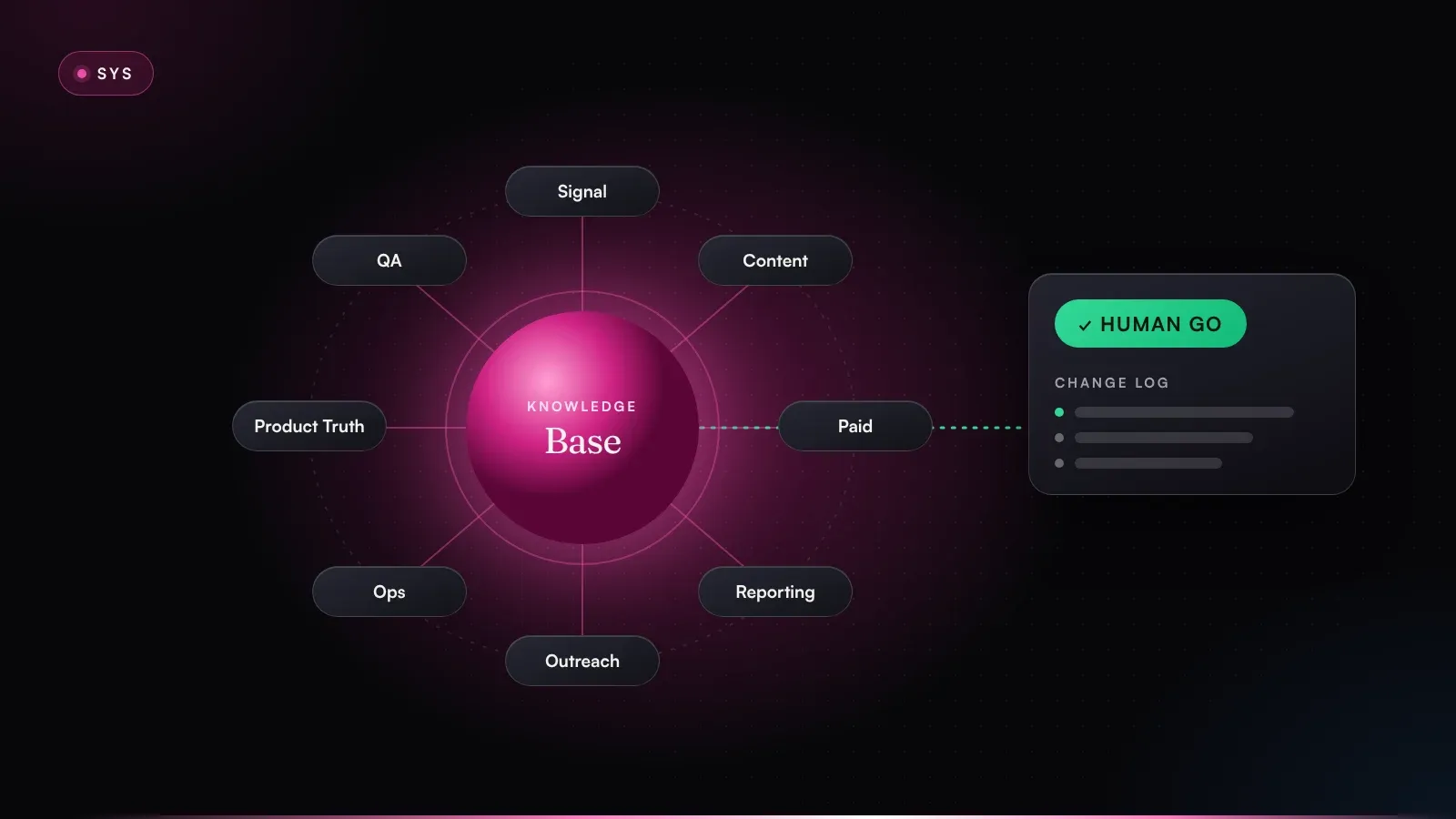
For the knowledge base itself, I start with two modules: the ICP including exclusion criteria, and one angle per segment and role. An agent that doesn't know who you don't want will research diligently in the wrong direction, and so will a new hire. How to structure the rest is in my article on the AI marketing knowledge base.
System first, hire second: the sequence I use
The order is always the same. Revenue logic comes first, then the data, and agents only come in once both are in place. The new hire joins a setup that already produces its first results.
- Weeks 1–2Revenue logicKnowledge base with owners, job profile rewritten
- Weeks 3–4Hub connectedApprovals, dashboards, change log
- From week 5First agentsTwo or three, launches after a go
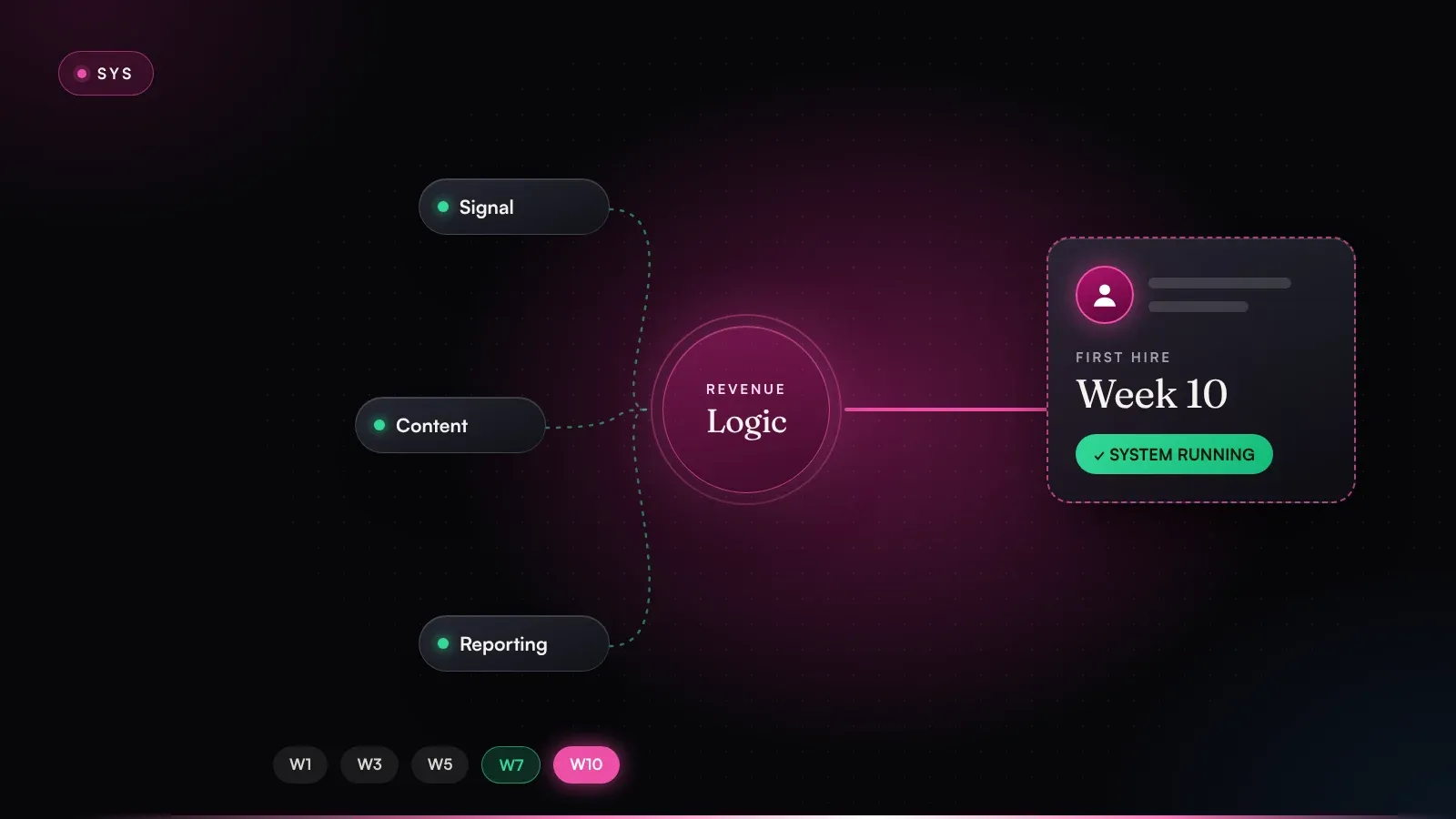
- Around week 10New hire joinsInto a running system
Typical flow. Week 10 comes from the observability case, and the pace depends on your stack and team.
The job profile belongs in the first two weeks. Once these basics are written down, it becomes obvious which decisions the new person will own and which recurring work agents will do. The profile then describes a real role in a real system.
Speed is rarely the bottleneck anymore. In my projects, a campaign set that took six to eight weeks without AI takes one to two weeks with chat tools and two to three days with RevPrime® agents. These are typical ranges and depend on setup and approvals. Pointed at the wrong ICP, that speed just produces more noise in less time. That's why the revenue logic comes first.
You should expect 30 to 90 days until the rhythm runs on its own and your team carries it. Permissions for agents grow with trust, starting at read and propose.
Example: from eleven founder-led customers to a running system
Back to the LLM observability company from the beginning. I started with a 90-day revenue marketing blueprint, before any hiring or campaign spend. Four things changed in that period.
- The hire profile was rewritten from head of marketing to revenue marketing lead.
- The ICP got sharper. It went from “anyone using LLMs” to platform teams at AI-first companies after their Series A. The signal agent gave the founder prioritized accounts to work from, which replaced gut feeling.
- Two entry plays went live: technical teardowns and a focused LinkedIn presence. The angle & content agent produced them from the founder's knowledge, with steering from week one.
- A pipeline reporting agent made the weekly numbers visible from the start.
| Result | Value |
|---|---|
| First marketing-sourced SQLs | Week 7, before the new hire started |
| New hire joins | Week 10, into a running system |
| Q1 pipeline against plan | 124 % |
| Time back for the founder | about 12 hours a week |
| Wrong-hire cost avoided | about €120k fully loaded, plus a year of runway |
Table: anonymized client project, figures as published in Case 05 of my case studies.
The part I'd point other founders to is week 7. The first SQLs came from the system before the new person had started. The hire then spent the first weeks improving something that already worked.
A job profile written this way fits on one page. The skeleton below is a shortened template that every company fills differently.
Mission: qualified pipeline from the ICP segments in the knowledge base
Owns: ICP and angle updates with the founder, weekly pipeline review with sales, budget proposals, go or no on agent drafts
Not in the first 90 days: building a team, a rebrand, new channels outside the plan
Works with: signal agent, angle & content agent, pipeline reporting agent
Reports to: founder or CEO
Judged after 90 days on: marketing-sourced SQLs, pipeline against plan, founder hours back
What the first hire owns, and what agents take over
The first marketing hire at this stage won't have a team of ten. That's fine, because a large part of what a ten-person team does is recurring work. In my guide I broke a typical team week of 400 hours down by type of work and assigned each type to agents or people. It's a model calculation, and the role mix and shares are my assumptions.
| Type of work | Share | Hours | Who does it | Hours left with people |
|---|---|---|---|---|
| Reading, analysis, reporting, monitoring | 25 % | 100 | Agents, read and propose only | 10 |
| Production and drafts: assets, ads, landing pages, lists | 30 % | 120 | Agents draft, nothing goes live without a go | 18 |
| Routine: CRM hygiene, routing, audiences, notes | 15 % | 60 | Agents on a rule approved once | 3 |
| Coordination, handoffs, status updates | 15 % | 60 | Mostly disappears | 10 |
| Judgment: priorities, positioning, budget, relationships, knowledge base | 15 % | 60 | People | 36 |
| Total | 100 % | 400 | 77, about 1.9 FTE |
Table: model calculation from the guide. If every judgment call stays with a person and a quarter of drafts need rework, the result is around 113 hours or 2.8 FTE.
The judgment row is the job description of your first hire. The guide describes two roles around the agents. The GTM owner sets the 90-day priorities, signs off on budget, runs the weekly with sales and owns ICP, priorities and angles. The GTM operator configures agents, writes the rules for routines and reviews drafts. In the guide, the owner role sits with the founder or the first revenue marketing lead. During the transition, the founder keeps parts of it until the new hire has grown into the role. The operator side can sit with the hire or with an external partner, depending on how technical the person is.
One limit matters here. Review load is the hard ceiling for a small team. Somebody who clicks approve 80 times a day stops reading. My design target is a single-digit number of go decisions per person per day. If it climbs higher, a routine moves to an approved rule or two agents get merged.
Mistakes I see founders make with the first marketing hire
Hiring before the sequence is clear
The job ad is the most visible step, so it often comes first. Without a written ICP and buying center, the new person spends months reconstructing what the founder knows, often by trial and error with real budget.
Adding channels before the system exists
A new hire wants to show results, and a new channel looks like a result. Every channel added without shared revenue logic makes the later reorg bigger.
Treating AI as a personal tool
When everyone prompts in their own way, the company gets faster output with no shared rules behind it. Agents amplify whatever is already there, clarity and chaos alike.
Measuring output when the board measures pipeline
Posts and MQLs are easy to count. If the 90-day review talks about volume while the board talks about pipeline, the hire gets judged against the wrong target.
Copying a generic SaaS playbook
Playbooks written for self-serve products or for much larger teams rarely fit a sales-led company with five-figure ACVs and long cycles. Your buying center and your angles are specific, and the first hire's work should start from them.
How to judge the first marketing hire after 90 days
Whichever profile you pick, agree on the yardstick before the first day. These are the numbers I look at:
- Marketing-sourced SQLs in the ICP, and the week the first one arrived.
- Pipeline against plan for the quarter, reviewed with sales every week.
- Hours the founder gets back from ad hoc marketing decisions.
- The share of agent drafts that need changes before the go. If it stays high, rules are missing in the knowledge base.
- Whether the weekly pipeline review ends in decisions.
If marketing is supposed to show up in the board deck, the yardstick has to be pipeline from day one. My article on sales velocity as a marketing KPI shows how to turn that into a weekly number.
My take: when to bring me in
I work with founders and CEOs at exactly this point, through my Build path. I set up revenue logic and knowledge base from day one, the AI marketing hub from week three and the first agents from week five. The first marketing hire then joins a system they can learn and improve.
Before that, I usually start with a revenue due diligence. For about three weeks, I go through your systems with read-only access, run five remote workshops and hand you a maturity analysis and a roadmap with your first two or three agents. At the end you get a straight answer: go, not yet, or no fit. The analysis is yours either way.
If your ICP is written down, the buying center is documented and the CRM is reliable, you may not need me. Hire the revenue marketing lead and give them a clear 90-day target. If you aren't sure where you stand, a 30-minute diagnosis call with me is free. I'll look at your setup with you and tell you whether the hire or the system should come first.
Frequently asked questions
Who should be the first marketing hire in a B2B SaaS startup?
For a sales-led B2B SaaS or AI company leaving founder-led sales, I usually recommend a revenue marketing lead: a person who owns pipeline together with sales, keeps ICP and message angles current and runs the weekly review. A head of marketing fits better once there's a system and a team to lead.
When should a B2B SaaS company make its first marketing hire?
When founder-led pipeline flattens and the company needs pipeline that doesn't depend on the founder's network. There's no fixed ARR threshold. The hire works best after the ICP and the buying center are written down, so the person joins a running system.
Head of marketing or marketing manager as the first hire?
For most sales-led companies at €1M to €25M in revenue that are just leaving founder-led sales, I'd hire a revenue marketing lead who owns pipeline with sales. A head of marketing expects a team and a budget to lead. A marketing manager needs priorities someone else has set. Both profiles fit better once a system exists.
What should be in place before hiring the first marketer?
A written ICP with exclusion criteria, a documented buying center, one message angle per segment and role, a CRM that reports deals and stages reliably, a weekly rhythm with sales and an agreed 90-day measure in pipeline. Without these, the new hire spends months reconstructing what the founder knows.
How much does a wrong first marketing hire cost?
In one anonymized client project, an LLM observability company at about €1.5M ARR, a wrong first marketing hire would have cost around €120k fully loaded plus a year of runway. Treat it as one example. Often the lost time before the next funding round is what hurts most.
Can AI agents replace the first marketing hire?
Agents can take over a large part of the recurring work: research, reporting, drafts and routine CRM tasks. Judgment stays with people. In my model calculation, about 77 of 400 weekly hours of a ten-person team stay with people. The first hire should own exactly that judgment.

About the author
Mario Maier
AI-native revenue marketing engineer · founder of igromo
For more than 15 years I've worked at the intersection of marketing, sales and revenue operations, from early-stage setups to scale-ups with multi-stage sales cycles and large buying centers. Since 2019 I've measured my work on pipeline and revenue.
Where do you stand?
The agentic readiness check shows in 3 minutes how ready your marketing is for agents – and which gaps to close first.
Keep reading
All insightsSYS24 min read
AI agents for B2B marketing: the complete guide from first prompt to pipeline
AI agents for B2B marketing that move pipeline: definition, architecture, 8 core agents with workflows, what not to automate, KPIs and a 90-day plan.
SYS12 min read
How to audit a B2B SaaS marketing funnel in three weeks: a week-by-week guide
A marketing funnel audit for B2B SaaS, week by week: the data and questions I use and how I rank findings by impact and effort. With checklists.
SYS12 min read
Agency, fractional CMO, in-house team or agent system: how B2B SaaS founders decide
Fractional CMO vs agency, in-house team or AI agents: seven criteria, a comparison and the cost logic for SaaS founders, plus when RevPrime® isn't a fit.