Content for AI answers: how B2B companies get cited in ChatGPT, Perplexity and AI Overviews
More and more B2B research now ends in a finished AI answer with a short list of vendors. AI search visibility decides whether you're on that list and whether you're described correctly. Below are the five levers I'd focus on to make content citable, a worked example and a plan for your first 30 days. No snake oil, and no guarantees either.
 ByMario Maier
Published 15 min read

Contents
- Your buyers aren't just asking Google anymore
- What is generative engine optimization (GEO)?
- How do AI engines pick their sources, and what do we know?
- Five levers that make content citable
- Do you need an llms.txt?
- Example: a TMS vendor makes itself citable
- What agents do and what your team decides
- How do you measure AI search visibility?
- Common GEO mistakes and what to do instead
- Your first 30 days
Your buyers aren't just asking Google anymore
“Which transport management systems work for a mid-sized shipper running SAP?” A few years ago, a buyer typed that into a search engine, opened ten tabs and worked through comparison sites, blog posts and vendor pages. Today, buyers increasingly put it to ChatGPT or Perplexity, or they read the answer straight from Google's AI Overviews. What comes back is a finished answer, often with a shortlist of vendors and two or three sources underneath. AI search visibility is the question of whether your company appears in that answer, and whether it's described correctly.
For B2B marketing, that's an uncomfortable shift. Miss the answer and you're less likely to make the shortlist, and you won't even find out. No ranking report tells you that you're “number seven in ChatGPT”. What you do see is fewer clicks on informational queries, the odd demo request that says “ChatGPT recommended you”, and a vague sense that research has moved somewhere you can't look.
I don't think the new interface is the real problem, though. Most B2B websites were built for a different game: keyword pages competing for rankings, whitepapers behind forms, and product pages full of superlatives that never quite say what the product does, for whom and on what terms. A language model trying to answer a precise question finds very little in there worth quoting.
Built for rankings
- One page per keyword
- Answer after 800 words
- Knowledge in a gated PDF
- Superlatives, not facts
Built for answers
- One page per buyer question
- Answer in paragraph one
- Open, clearly structured
- Evidenced, dated facts
Many B2B websites are optimized for the results page. AI answers need clear statements anyone can read.
AI answers don't reward the loudest content. They reward the least ambiguous. Say plainly what you do, for whom and where your limits are, and you make life easy for models. For buyers too, as it happens.
What is generative engine optimization (GEO)?
Generative engine optimization, or GEO for short (sometimes called answer engine optimization, AEO), covers everything you do so that generative search systems include your content in their answers: as a source, a quote or a named vendor. The term comes from academic research; a widely cited 2023 paper coined it, and it has spread quickly through marketing since.
One thing I want to get out of the way early: GEO doesn't replace SEO. For anything current, many AI systems lean on a search index, and if you can't be found there, you won't be cited either. What changes is the goal, which moves from “a click to my page” to “my statement makes it into the answer, intact”.
| Aspect | Classic SEO | Generative engine optimization |
|---|---|---|
| Goal | Position in the results | Mention and citation in the answer |
| Unit | Page and keyword | Statement, passage and entity |
| Success metric | Rankings, clicks, click-through rate | Mentions, citations, accuracy, pipeline |
| What matters | Relevance, links, technical health | All that, plus clarity, evidence, consistency |
| Biggest risk | Invisible on page two | Described wrongly – or not at all |
There are two routes into an AI answer. The first is what a model learned in training, which reflects whatever picture of your company existed on the web at the time, outdated claims included. The second is live retrieval: ChatGPT with web search, Perplexity and Google's AI Overviews pull in sources relevant to the question and summarize them. You can only shift the first slowly. The second responds far more directly to what you publish this month.
How do AI engines pick their sources, and what do we know?
I'll say this up front: nobody outside the providers knows the exact criteria. The systems are built differently, change constantly and don't always give the same answer to the same question, because phrasing, language, location and conversation history all shift the result. Anyone promising you guaranteed placement is selling a certainty that doesn't exist.
You can still infer a fair amount from how these systems work and from practice. Findability comes first. Content the underlying index can't reach starts at a disadvantage, and that covers anything behind a form, PDFs without machine-readable text and pages that only render via JavaScript. These systems also work with chunks of text, so a paragraph that answers a question directly is easier to use than an answer spread across three pages.
Agreement across sources matters as well. When your website, review platforms, trade articles and profiles all say the same thing about you, a stable picture forms; contradictions raise the odds that a model repeats the wrong version. For questions about pricing, features or integrations, dates count, and visibly maintained content has the edge. Vendor recommendations in particular tend to lean on third-party mentions in comparisons, reviews and trade media. Your own site is only part of what gets read.
Google itself says, in essence, that appearing in AI Overviews needs no special optimization. The same fundamentals as for search apply, meaning helpful, accessible content. I find that a useful reality check, because it takes the mystery out of GEO. Most of it comes down to care in places many B2B websites have neglected for years.
You can't optimize for an algorithm you can't see. You can optimize for the questions your buying center asks, and make sure every answer to them is unambiguous, evidenced and current.
Five levers that make content citable
- 01Answer firstQuestion answered in paragraph one
- 02Evidence & experienceWhat only your team knows
- 03Product truthCurrent facts, dated
- 04Entity clarityOne sentence, used everywhere
- 05Technical accessHTML, crawler rules, schema
Bottom to top: each layer depends on the one below it.
The levers build on each other from the bottom up. Without technical access, the best answer goes nowhere, and without entity clarity even a strong article gets filed under the wrong category or credited to the wrong company.
1. Answer first
Every important page answers one question, in its first paragraph, in two or three sentences. Depth comes after that, with conditions, exceptions and examples. Write headings the way people ask. “How much does a transport management system cost?” helps a buyer; “Our pricing philosophy” helps nobody. Give definitions their own paragraph with clear edges. You could call this writing for machines, but a good subject-matter writer would do it anyway.
2. Evidence and experience
Models already have the general knowledge. What they can take from you is the specific stuff: concrete processes, timelines, prerequisites, typical failure points, your own data and project examples. An article that rehashes what twenty others have already said gives a model no reason to pick it over the rest. Name authors whose expertise can be checked, and say where every number comes from.
3. Product truth
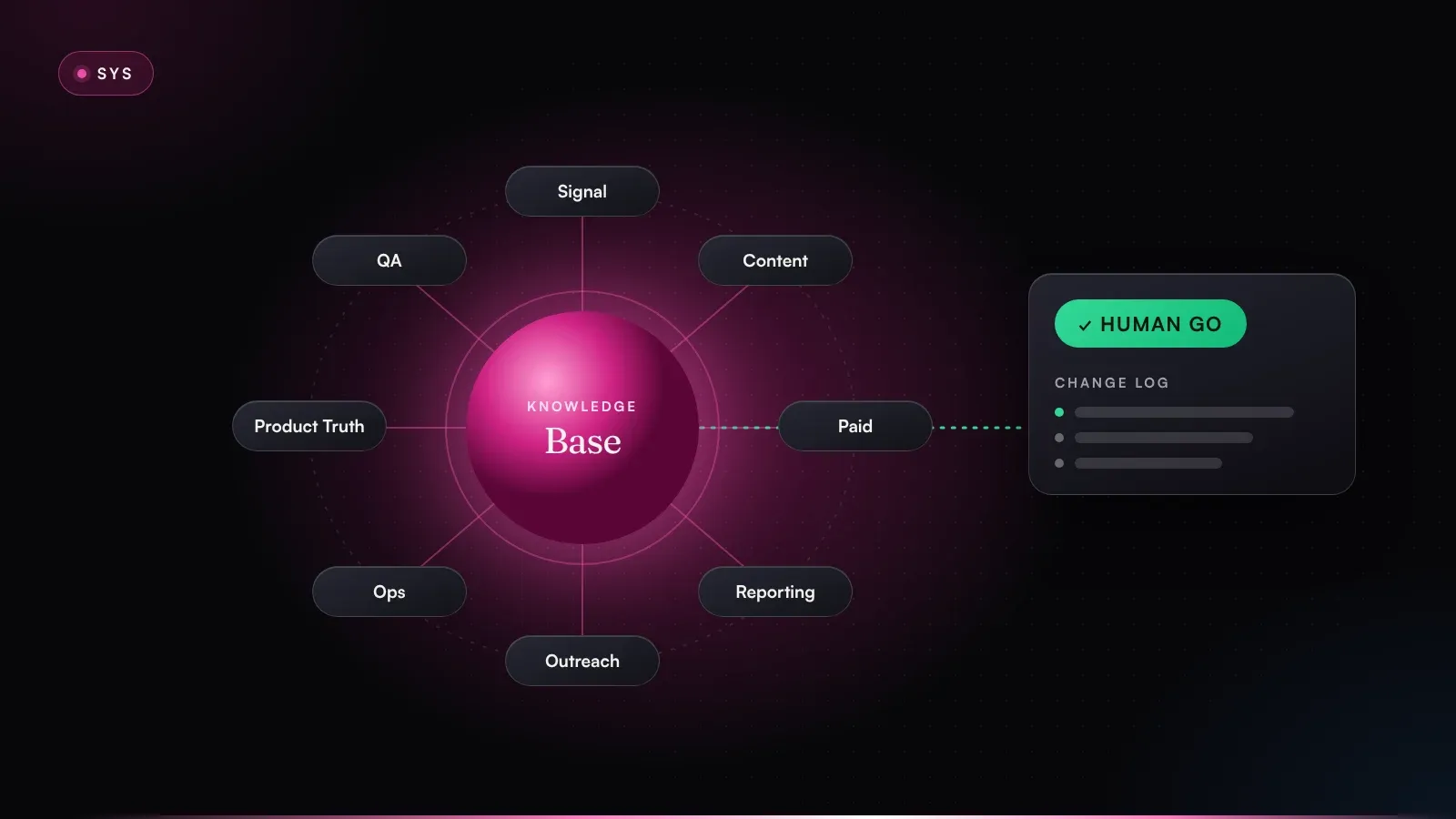
AI answers repeat what's on the web, even when it's no longer true. Outdated integration lists, retired pricing models or limitations you fixed two releases ago then surface in answers your buyer assumes are neutral. So you need a maintained, public source of truth with current features, integrations, pricing logic, limitations and dated release notes. Internally, that's the product truth module in the RevPrime® knowledge base, which every agent works from.
4. Entity clarity
To a model, your company is an entity with attributes: name, category, audience, location, founder, products. If your homepage talks about a “platform for supply chain excellence”, LinkedIn says “logistics software” and an old press release says “fleet management”, the picture blurs. Settle on one sentence, say “Lanefield is a transport management system for mid-sized shippers in the DACH region that plans, tenders and tracks freight”, and use it everywhere: website, about page, LinkedIn, review platforms, press boilerplate. That sounds trivial. It can still take a while, because leadership, sales and marketing have to agree on a single wording. Structured data, such as Organization schema pointing to your official profiles, then helps connect the pieces.
5. Technical access
The basics are unglamorous but decisive. Content has to be served as HTML, which rules out PDF-only pages and text that only appears once JavaScript runs. Add a sitemap with last-modified dates, fast pages and structured data for articles, organization and product. Your robots.txt also needs a deliberate decision. Some providers separate crawlers used for training from crawlers used for search; OpenAI, for example, distinguishes GPTBot from OAI-SearchBot. Block everything wholesale and you may shut yourself out of the answers, too. Check each provider's current documentation before you decide.
Do you need an llms.txt?
llms.txt is a format proposed in 2024: a Markdown file at the root of your site that explains in a few lines who you are, what you offer and which pages hold the key information. The idea is to give language models and agents a compact, reliable summary so they don't have to dig through navigation and cookie banners.
How much it helps is an open question. Whether and how the major providers use the file when generating answers isn't documented in any binding way so far, so it's not a ranking lever. I'd still do it, for two reasons. First, it forces you to state your positioning unambiguously in ten lines, which is the same entity work as lever 4. Second, some agents and developer tools already use it, and it only takes a few hours. You can see one way to do it on this site's llms page. For the example company in the next section, a first draft might look like this:
  # Lanefield
  > Lanefield is a transport management system (TMS) for
  > mid-sized shippers in the DACH region. It plans, tenders
  > and tracks freight – with an SAP S/4HANA integration.

  Last updated: October 2026. Older sources describe Lanefield
  as fleet management software. That is outdated.

  ## Product
  - Features: https://www.example.com/features
  - Integrations (SAP S/4HANA since release 4.2): https://www.example.com/integrations
  - Pricing logic and cost drivers: https://www.example.com/pricing

  ## Guides
  - What does a TMS cost?: https://www.example.com/guides/tms-cost
  - Rolling out a TMS in 90 days: https://www.example.com/guides/rollout
Example: a TMS vendor makes itself citable
A fictional but typical scenario. Lanefield (a made-up name) sells transport management software, has 70 employees and serves mid-sized shippers in the DACH region at an average contract value of around €40,000 a year. A typical buying center includes the head of logistics, the CFO and IT. The marketing team has five people and a well-kept blog. Still, there's a nagging suspicion that AI answers name every vendor but them.
Week 1: the baseline
Before changing anything, the team builds a prompt panel: 36 questions, twelve per role, phrased the way buyers ask them. “Which TMS solutions integrate with SAP S/4HANA?”, “What does it cost a mid-sized company to implement a TMS?”, “How long does a TMS rollout take?”. Every question runs in ChatGPT, Perplexity and Google, twice each, because answers vary. The Product Truth Agent evaluates the answers and checks them against the product truth in the knowledge base. What it hands back is a proposal. Nothing has been changed yet:
Panel: 36 questions × 3 engines × 2 runs · Level L1: proposals only

VISIBILITY
  Named in at least one answer:   5 of 36 questions
  Linked as a source:             3 of 36 questions
  Role with no mention at all:    CFO (0 of 12)

CONFLICTS WITH PRODUCT TRUTH
  RED     Perplexity, question 14: “no SAP integration”
          Source: comparison portal, last updated 2022
          Product truth: S/4HANA connector since release 4.2
  YELLOW  ChatGPT, questions 3 and 9: category “fleet management”
          Likely source: 2021 press release, old about page

GAPS
  CFO questions on cost and ROI: no open page exists
  ROI guide only available as a gated PDF

PROPOSALS                                         DECISION
  P1  Align one-sentence definition on website,  Go / No-go
      LinkedIn and review platforms
  P2  Integrations page: S/4HANA with release    Go / No-go
      date, link the public changelog
  P3  Correction request to comparison portal    Go / No-go
      (draft attached, sent by a human)
  P4  New page “What does a TMS cost?” –         Go / No-go
      cost drivers and ranges, not a price list
  P5  Turn the ROI guide into an open HTML page  Go / No-go
Weeks 2 to 8: fix what matters
The marketing lead approves P1, P2, P4 and P5. The CEO sends P3 personally because they know the portal's operator. The Angle & Content Agent drafts twelve answer pages for the most important panel questions, each with the answer up front, a specific role in mind and evidence from projects. People from implementation and sales add what no agent can know, like actual project timelines, typical pitfalls and where the product stops. I'd argue that's the most valuable part. Before anything is published, the QA & Brand Guard Agent checks claims, links and structured data, and each page goes live only after its own go.
Week 9: the second measurement
Same panel, same engines. Suppose the result looks like this: Lanefield is now named in 11 of 36 questions, the wrong category only appears sporadically, and Perplexity links the new integrations page for the SAP question. On two CFO questions Lanefield is still invisible, because comparison portals own those answers. Analytics shows the first visits with chatgpt.com and perplexity.ai as the source, and one demo request answers “How did you hear about us?” with a plain “ChatGPT recommended you”.
None of this proves cause and effect. The engines changed over those eight weeks too, and individual runs vary. Still, the direction is right, the misinformation is fixed, and the team no longer has to guess where it stands.
What agents do and what your team decides
- 01Run the panelQuestions × engines × runs
- 02CompareAnswers vs. product truth
- 03ProposalsDrafts, fixes, corrections
- GOGoOwner decides per page
- 05Publish & logChange log, next measurement
Agents measure, compare and draft. Nothing is published until the owner gives the go.
GEO doesn't stop after a campaign, which is why it suits agents so well. Running the panel, evaluating answers, comparing them with product truth, preparing drafts, finding technical errors: that routine is extensive and recurring, but easy to check. The decisions stay with people. How do we position ourselves? Which questions matter to us, which claims can we make in public, and what goes live?
| Task | Who | Level |
|---|---|---|
| Run and evaluate the prompt panel | Product Truth Agent | L0 read, L1 propose |
| Flag gaps between AI answers and the product | Product Truth Agent | L1 propose |
| Draft answer pages from buying-center questions | Angle & Content Agent | L1; publishing L2 write after go |
| Check claims, links, schema and outdated numbers | QA & Brand Guard Agent | L1; fixes L2 write after go |
| Map visitors from AI sources to accounts | Signal Agent | L0 read, L1 alert to sales |
| Report AI traffic and pipeline links | Pipeline Reporting Agent | L1 propose |
| Set positioning and the one-sentence definition | Human: marketing lead | Decision |
| Publish each page | Human: page owner | Single go |
| Talk to portals, trade media and partners | Human | Not delegated |
The levels follow the permission ladder in our governance model: read, propose, write after go, approved rule. For GEO, L0 and L1 cover almost everything in the first few months. Every publication needs its own go, because in my setups content with external effect never runs on a blanket rule. Every change lands in the change log, with before and after.
One detail that's easy to miss: whatever an agent reads in AI answers and on third-party pages, it treats as data. It doesn't take instructions from there. If a comparison page hides a prompt aimed at language models, that prompt doesn't become a rule in your system. For how the roles fit together, see the overview of agents in the RevPrime® OS.
Agents make GEO affordable because they take on the legwork. What makes your content worth citing is what only your team knows.
How do you measure AI search visibility?
Without measurement, GEO becomes a matter of faith, and yet no single number is reliable on its own. I work with a bundle of direct and indirect signals and look at the trend over several months. One run on its own tells you very little.
| Metric | How to collect it | Watch out |
|---|---|---|
| Mention rate in the panel | Fixed question set, monthly, several engines and runs | Answers vary – only trends count |
| Linked citations | Count sources cited in Perplexity, ChatGPT search and AI Overviews | Engines display sources differently |
| Accuracy | Check answers against product truth: category, features, pricing | Matters more than the mention itself |
| AI referral traffic | Filter analytics by sources such as chatgpt.com or perplexity.ai | Clicks from AI Overviews usually show up as regular Google search |
| Self-reported source | Open field “How did you hear about us?” on the demo form | Read the free text, not just a dropdown |
| Pipeline link | Opportunities with AI sources or answer pages in their history | Correlation, not clean attribution |
The row that matters most is the third. A mention with the wrong category or an outdated feature set is worse than none at all, because it rules you out before anyone has spoken to you. The last row decides whether GEO stays a marketing hobby or becomes a pipeline lever. The Pipeline Reporting Agent ties these signals to the CRM every week, so the weekly meeting can talk about specific accounts instead of visibility in general.
Connect AI search visibility with company-level identification and the loop closes. A visitor from an ICP account who arrives via an AI source is a signal like any other and runs through the same loop of research, buying center and personal outreach. I cover how that works without a download form in ungated inbound.
Common GEO mistakes and what to do instead
- Going for volume: a hundred AI-generated posts on long-tail keywords mostly create noise. Twelve precise answer pages beat a hundred generic ones.
- Relying on tricks: hidden instructions for models, keyword lists in the footer, padded FAQs. At best it does nothing; at worst it damages your reputation with people and systems alike.
- Your best answers behind forms: an ROI guide locked in a gated PDF is invisible to AI systems. Whatever you want cited has to be openly readable.
- Contradictory facts: three pages quote three different customer counts, and the integrations list is two releases old. When in doubt, models pick the wrong version.
- Only looking at your own site: for vendor questions, answers often lean on review platforms, comparisons and trade media. An outdated profile there costs you, however good your own site is.
- Measuring once and moving on: a screenshot of a ChatGPT answer isn't measurement. Without a fixed panel and regular repeats, you're looking at noise.
- Promising rankings: tell the board you'll be “number one in ChatGPT” and you have a problem the day the next model ships. I'd promise accuracy and a measurable trend instead. Less exciting, but you can actually keep that promise.
Your first 30 days
- Week 1Questions & baselineBuild the panel, first run
- Week 2Entity & factsDefinition, product truth, tech
- Week 3First answer pagesClose five gaps, one go each
- Week 4Measure & cadenceTracking, self-reporting, weekly meeting
A realistic start: measure and fix the facts first, then ship the first answer pages.
GEO doesn't start with a tool. It starts with a list. Write down the questions prospects ask in first calls, sorted by role in the buying center. That list doubles as your prompt panel and your content plan, and it sits at the core of inbound marketing 2.0.
- Collect 30 to 50 real buyer questions from sales calls and support tickets, sorted by buying-center role
- Measure a baseline: every question in ChatGPT, Perplexity and Google, at least twice
- Agree on one sentence that defines your company and align it across website, LinkedIn and review platforms
- Audit your product truth: features, integrations, pricing logic and limitations, each with a date
- Make a deliberate call on crawler rules in robots.txt; check sitemap and structured data
- Turn the five most important questions without a good answer into answer pages
- Review gated content: what should be cited and therefore has to be openly readable?
- Draft an llms.txt (treat it as an exercise in clarity; it won't move rankings)
- Add a self-reported source field to the demo form and make AI sources visible in analytics
- Set a cadence: panel monthly, trend report in the weekly meeting
After 30 days, nobody can guarantee you'll appear in every answer. You will know where you stand, you'll have tackled the worst misinformation, and you'll have a way of working that gets better every month. If you'd like to go through your panel, your product truth and the right agents with me, a short diagnosis call is the fastest next step.
Frequently asked questions
What is generative engine optimization?
Generative engine optimization (GEO) is the practice of shaping content so that AI systems such as ChatGPT, Perplexity or Google AI Overviews can find it, understand it and use it as a source in their answers. At its core, it means direct answers, evidenced and current facts, an unambiguous description of your company and technically accessible pages. Nobody can guarantee that you will be mentioned.
What is the difference between SEO and GEO?
SEO aims for strong positions in search results and the clicks that follow. GEO aims for your statements to be carried accurately into AI answers and cited. The two are connected, because many AI systems rely on search indexes for current questions. So GEO builds on SEO.
How do I get my company cited by ChatGPT?
You can't control it, but you can make it more likely. Answer the questions your buyers ask, openly and directly. Keep facts about your product, integrations and pricing logic current, and describe your company the same way everywhere, including review platforms and profiles. And make sure the crawlers that power AI search can reach your pages.
Does an llms.txt file improve AI search visibility?
Not as a ranking lever. Whether and how the major providers use it to generate answers isn't clearly documented so far. An llms.txt is a short Markdown file that tells AI systems and agents who you are and which pages matter. I'd still write one, because the effort is small and it forces you to describe your offering unambiguously.
How can I measure whether my company appears in AI answers?
The most reliable method is a fixed prompt panel: 30 to 50 buyer questions from sales calls and support tickets, run monthly across several AI systems, several times each. Add referral traffic from sources such as chatgpt.com or perplexity.ai in your analytics, and ask on your demo form how prospects heard about you. It only becomes meaningful over several months, and accuracy counts for more than any single mention.
Should I block AI crawlers in robots.txt?
I wouldn't make a blanket decision either way. Some providers separate crawlers used for training from crawlers used for search, so you can, for example, allow one and block the other. Blocking everything may also remove you from AI answers. Check each provider's current documentation and align the decision with your data protection and legal teams.

About the author
Mario Maier
AI-native revenue marketing engineer · founder of igromo
For more than 15 years I've worked at the intersection of marketing, sales and revenue operations, from early-stage setups to scale-ups with multi-stage sales cycles and large buying centers. Since 2019 I've measured my work on pipeline and revenue.
Where do you stand?
The agentic readiness check shows in 3 minutes how ready your marketing is for agents – and which gaps to close first.
Keep reading
All insightsINB14 min read
Ungated inbound: when to drop the form – and how to capture demand without it
An ungated content strategy without forms: when gating still pays off, how to capture demand via signals and measure pipeline. Plus a 30-day plan.
SYS24 min read
AI agents for B2B marketing: the complete guide from first prompt to pipeline
AI agents for B2B marketing that move pipeline: definition, architecture, 8 core agents with workflows, what not to automate, KPIs and a 90-day plan.
SYS12 min read
Your first marketing hire after founder-led sales: who to hire and what to build first
Your first marketing hire after founder-led sales: which profile fits, what to build before the job ad and how to judge the hire after 90 days. With a case.