EU AI Act for marketing teams: what applies since August 2026
Since August 2, 2026, the AI Act’s transparency obligations apply. The AI Omnibus only postponed the high-risk deadlines; it left labeling alone. This guide to the EU AI Act marketing rules covers deadlines, roles, prohibitions, labeling and the GDPR overlap, with a worked example and a checklist for marketing leads. It also shows how to build all of this into your systems so it doesn’t end up slowing marketing down.
 ByMario Maier
Published 22 min read
Contents
- Why the EU AI Act is now a marketing problem
- What applies when? EU AI Act marketing deadlines after the AI Omnibus
- Provider or deployer: what role does your marketing team play?
- Prohibited or high-risk? The risk tiers in marketing
- Article 50 transparency: chatbots, deepfakes and AI-generated text
- What does this mean for your marketing use cases?
- GDPR and the AI Act: where the obligations overlap
- Building it in: human go, change log, permission ladder
- Common EU AI Act marketing mistakes
- How to start: checklist and 90-day plan
- My take: governance as architecture, not as a brake
Why the EU AI Act is now a marketing problem
As of August 2, 2026, the EU AI Act marketing rules are no longer a future topic. The transparency obligations in Article 50 apply, national authorities can enforce them, and most marketing teams already run chatbots, image generators, writing assistants and their first agents. Yet when I talk to marketing leads, I usually hear one of two reactions. Either: “Doesn’t affect us, we don’t do anything high-risk.” Or: “We’ll wait until legal tells us what we’re allowed to do.”
I get both reactions, and both turn out to be expensive. The first one misses that labeling, AI literacy, prohibited practices and GDPR apply regardless of risk class. The second leads to marketing either not using AI at all or using it quietly, on personal accounts with no rules and no log. In my projects, that second scenario is the more common one.
On top of that, the law itself has moved. With the AI Omnibus, Regulation (EU) 2026/1744, the EU postponed the deadlines for high-risk systems in July 2026. Plenty of newsletters turned that into “the AI Act has been delayed,” which isn’t what happened. The part that hits marketing most directly has applied since August.
What follows is my read on what has applied to marketing since August 2026: which deadlines are running, what role your team plays, what’s prohibited and what typically isn’t high-risk, when you have to label and how GDPR fits in. After that comes the practical part, how to put all of it into the architecture of your systems so it doesn’t become a brake. There are two tables, a worked example and a checklist for marketing leads along the way.
Important: this article is not legal advice. I’m an engineer, not a lawyer. I describe how I implement these rules in marketing systems and link the primary sources. Whether and how an obligation applies in your specific case is something to clarify with your legal team and your data protection officer – ideally before any agent gets write access.
What applies when? EU AI Act marketing deadlines after the AI Omnibus
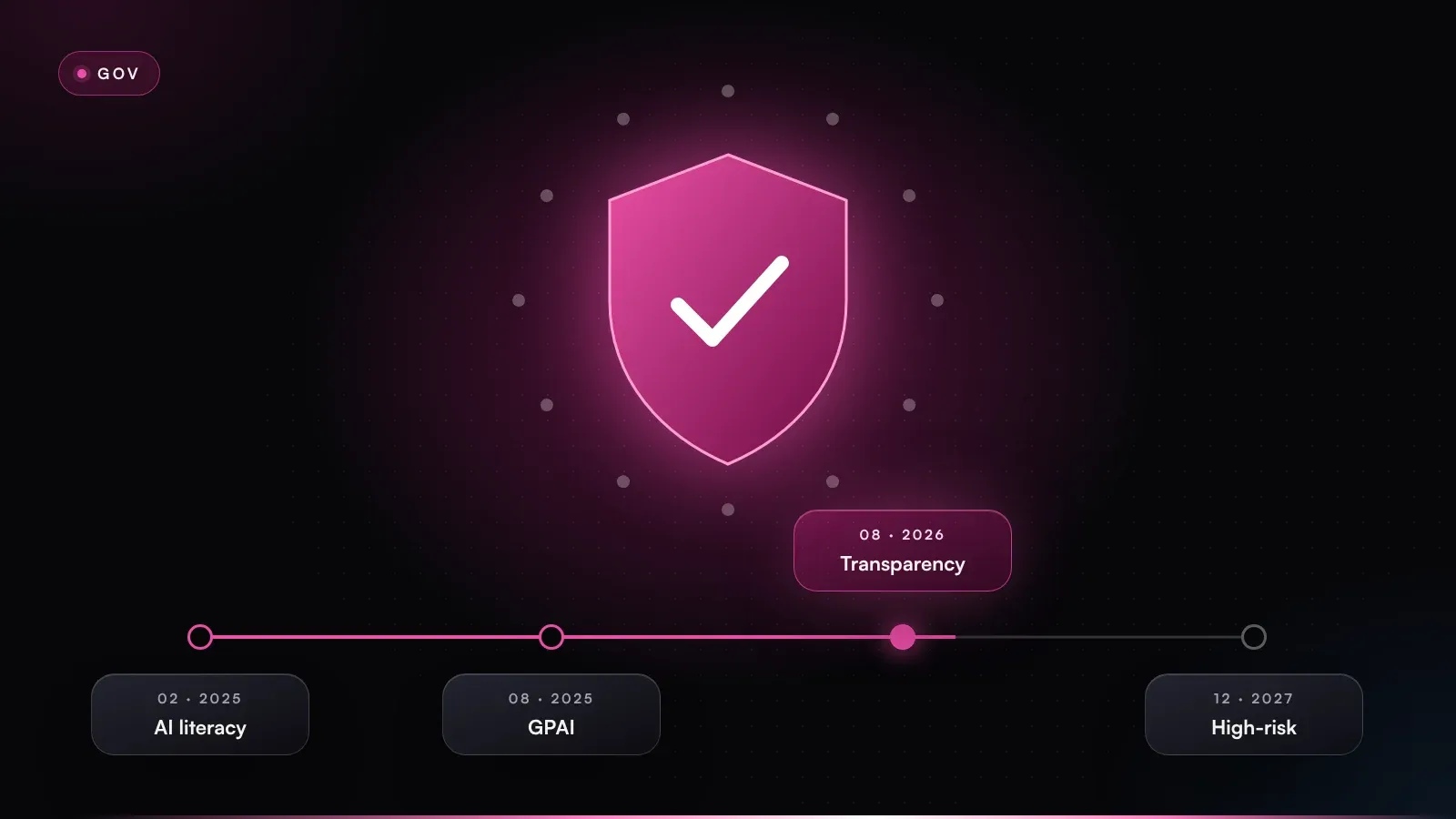
The AI Act, Regulation (EU) 2024/1689, entered into force on August 1, 2024, but applies in stages, which makes it hard to follow. No surprise, then, that so many teams don’t know what’s already binding today. The dates that matter for marketing:
- Feb 2025Bans & AI literacyArt. 5 and Art. 4
- Aug 2025GPAI modelsDuties of model providers
- Aug 2026TransparencyArt. 50: chatbots, deepfakes, text
- Dec 2026Legacy markingArt. 50(2) transition ends
- Dec 2027High-risk Annex IIIe.g. job-ad targeting
- Aug 2028High-risk Annex IAI in regulated products
As amended by the AI Omnibus (Regulation (EU) 2026/1744). The high-risk obligations moved – Art. 50 transparency has applied since August 2026.
| Since / from | What applies | Relevance for marketing |
|---|---|---|
| February 2, 2025 | Prohibited practices (Art. 5) and AI literacy (Art. 4) | High: applies to every team using AI |
| August 2, 2025 | Obligations for providers of general-purpose AI models, penalty rules | Indirect: hits model providers, not your team |
| August 2, 2026 | Transparency obligations (Art. 50), enforcement by national authorities | High: chatbots, deepfakes, certain AI-generated text |
| December 2, 2026 | End of the transition period for marking by legacy generative systems (Art. 50(2)), new ban on so-called nudifier apps | Medium: mostly affects your tool vendors |
| December 2, 2027 | High-risk obligations for Annex III systems (originally August 2, 2026) | Only for high-risk use cases, e.g. job-ad targeting |
| August 2, 2028 | High-risk obligations for AI in regulated products (Annex I) | Barely relevant for marketing |
The AI Omnibus is the AI part of the digital omnibus package the Commission proposed in November 2025. Parliament and Council reached a political agreement in early May 2026, Parliament endorsed it in June and the Council gave its final approval on June 29, 2026. The Council’s timeline documents the steps. The regulation was published in the Official Journal on July 24, 2026, and has been in force since July 27.
Three changes matter for marketing. First, the high-risk obligations arrive later; none of them were dropped. Second, Article 50 has applied since August 2, 2026, essentially as originally adopted. The only relief is a transition until December 2, 2026, for machine-readable marking by providers of generative systems that were already on the market before August 2, 2026; Taylor Wessing has a good summary of the compromise. Third, the AI literacy duty in Article 4 was reworded. It still exists, and I’ll come back to it below.
The AI Omnibus postponed high-risk, not transparency. If your marketing team was waiting for “postponed,” it was waiting for the wrong part.
Provider or deployer: what role does your marketing team play?
The AI Act assigns obligations by role. The two that matter most are defined in Art. 3. Providers develop an AI system, or have one developed, and place it on the market or put it into service under their own name. Deployers use an AI system under their own authority in a professional context.
In marketing, you’re a deployer in the vast majority of cases: you use Claude, ChatGPT, an image generator or the AI features in your CRM. The makers of those systems are the providers. The line is blurrier than most people think, though. If you build your own website chatbot on top of a model via API and run it under your brand, you can become the provider of that AI system, and then the provider obligations in Article 50 are yours. For high-risk systems, Art. 25 also defines when a deployer turns into a provider, for instance through a substantial modification or a new intended purpose.
| Setup | Typical role | What it means for you |
|---|---|---|
| SaaS tool with an AI feature, e.g. text suggestions in your CRM | Deployer | Art. 4, Art. 5 and Art. 50(4) for deepfakes and certain text |
| Generative model used directly in chat or via API for content | Deployer | As above; marking under Art. 50(2) sits with the provider |
| Your own chatbot on a model, run under your name | Often provider of the AI system and deployer | Plus Art. 50(1): people must know they’re talking to AI |
| A service partner builds agents inside your tools | Depends on contract and actual control | Put the allocation of roles in writing |
| A model company supplies the base model | Provider of a general-purpose AI model | Its own obligations since August 2025, not yours |
As a rule of thumb, I write down for every AI system in marketing who’s the provider and who’s the deployer, with one sentence of reasoning. It takes ten minutes per system and saves you the argument about who’s actually responsible later. In RevPrime® projects this is part of the hand-over: you’re usually the deployer, the model company is the provider of the general-purpose model, and for special cases like your own chatbot we settle the role together with your legal team.
Prohibited or high-risk? The risk tiers in marketing
The AI Act is risk-based. The higher the risk a use case poses to health, safety and fundamental rights, the stricter the rules. For marketing, that translates into five levels, and the bottom one applies to everyone.
- 01ProhibitedArt. 5 – e.g. manipulation, emotions
- 02High-riskAnnex III – e.g. job-ad targeting
- 03Transparency dutyArt. 50 – chatbots, deepfakes
- 04Minimal riskMost marketing use cases
- 05Base for everyoneAI literacy (Art. 4) and GDPR
The higher the tier, the stricter the rules. Most marketing use cases sit near the bottom – but the base layer always applies.
What’s prohibited in marketing
The prohibitions in Art. 5 have applied since February 2, 2025. The Commission set out its interpretation in its guidelines on prohibited AI practices. Four of them are relevant for marketing:
- Manipulative or deceptive techniques, such as subliminal cues beyond conscious awareness, that materially distort people’s behavior and cause, or are reasonably likely to cause, significant harm.
- Exploiting vulnerabilities due to age, disability or a specific social or economic situation, for example a system that deliberately targets people in financial distress with risky offers.
- Emotion recognition in the workplace, except for medical or safety reasons. A tool that reads your SDRs’ emotions from voice or face during calls falls under this, even when it’s sold as “coaching.”
- Biometric categorization that infers sensitive traits such as political opinions, religion or sexual orientation from biometric data, even if it’s only for audience segments.
Add social scoring and a few practices that rarely come up in marketing. From December 2, 2026, the AI Omnibus adds a ban on systems that generate non-consensual intimate imagery. The threshold matters. Normal personalization, A/B tests and persuasive copy aren’t prohibited; the ban targets techniques that significantly distort decisions and cause harm. An internal line still pays off. Dark patterns, fake scarcity and pressure on vulnerable groups are bad marketing with or without the AI Act, and AI just scales them faster.
What typically isn’t high-risk in marketing
High-risk systems are listed exhaustively: in Annex III for specific areas of use, in Annex I for AI in regulated products. Everyday marketing use cases aren’t on those lists. Content creation, campaign optimization, reporting, SEO, account research, B2B lead and account scoring, website and email personalization: none of these carry high-risk obligations. Art. 4, Art. 5, Art. 50 and GDPR still apply.
Where marketing can still end up high-risk
Recruiting campaigns are the obvious case. Annex III explicitly lists AI systems used for recruitment, in particular to place targeted job advertisements. If your team runs employer branding or recruiting ads with AI-driven targeting, put that under review.
Credit and insurance are on the list too: assessing the creditworthiness of natural persons, and risk assessment and pricing in life and health insurance. That becomes relevant if marketing in fintech or insurtech derives offers or terms automatically. Annex III also covers systems intended to influence voting behavior in elections and referendums (purely organizational and logistical campaign tools are excluded), as well as emotion recognition and biometric categorization outside the prohibitions, for example of visitors at events.
After the AI Omnibus, high-risk obligations for these cases apply from December 2, 2027. I wouldn’t treat that as breathing room. If you build recruiting targeting today, you’re building it for a regime that kicks in a little over a year from now.
Most marketing use cases aren’t high-risk. That still doesn’t make them unregulated.
Article 50 transparency: chatbots, deepfakes and AI-generated text
Article 50 is the part of the AI Act that hits marketing most directly. In July 2026, the Commission published guidelines on the transparency obligations, alongside a voluntary code of practice on marking and labeling AI-generated content. Neither is legally binding, but both shape how authorities read the rules. Four cases matter for marketing.
Chatbots and agents talking to customers
AI systems that interact directly with people must be designed so that those people know they’re dealing with AI, unless that’s obvious to a reasonably well-informed person. The obligation in Art. 50(1) formally sits with the provider, and according to several law firms the guidelines read “obvious” narrowly. For your website chatbot, that means a visible notice right at first contact. Burying it in the terms won’t do.
It gets more interesting with agents that communicate externally on their own (say, an AI SDR that replies to prospects by itself). Commentators read the guidelines as saying that an agent interacting directly with people should disclose both that it’s AI and the company it acts for. Whether an email drafted by an agent, reviewed by a human and sent under that human’s name falls under this is a matter of interpretation. I’d make that call deliberately and write down why. More in my article on AI SDRs in B2B.
Machine-readable marking of synthetic content
Providers of generative systems must mark outputs (text, image, audio, video) as artificially generated in a machine-readable way, for example through metadata and watermarks. That’s Art. 50(2), and it’s a provider obligation, so it sits with the makers of your tools rather than your content team. In practice, your part is simple: don’t strip those markings, and ask your vendors how and from when they comply. For legacy systems, the transition runs until December 2, 2026.
Labeling deepfakes
Here you’re directly on the hook as a deployer. Under the AI Act, a deepfake is AI-generated or manipulated image, audio or video content that resembles existing people, objects, places or events and would falsely appear to be authentic. If you publish that kind of content, Art. 50(4) requires you to disclose that it was artificially generated or manipulated. For evidently artistic, creative, satirical or fictional work, a notice that doesn’t spoil the work is enough.
Typical marketing cases are a testimonial video where a real customer’s voice was translated with a voice clone, or the CEO video in five languages with AI lip-sync. A photorealistic image of an event that never happened that way needs a label too. An obviously stylized illustration for a blog post usually doesn’t.
AI-generated text on matters of public interest
Text generated or manipulated by AI and published to inform the public on matters of public interest must be labeled as well. The exception matters a lot for marketing: the obligation doesn’t apply if the text has gone through human review or editorial control and a natural or legal person holds editorial responsibility for the publication.
Two things follow. Ordinary ad copy, product descriptions and sales emails are, by most readings, not text on matters of public interest; a white paper on industry regulation, a research report or a commentary on health or sustainability topics may well be. The exception also requires an actual review. Proofreading or a grammar check doesn’t count, according to analyses of the guidelines. If you let AI rewrite the text again after sign-off, that version no longer has the review behind it.
Proofreading isn’t editorial control. If you want to rely on the exception, you need a person with responsibility and proof that they reviewed it.
Art. 50(5) applies to every notice: it must be clear and distinguishable and given at the latest at the first interaction or exposure. Deployers of emotion recognition or biometric categorization must also inform the people exposed to it. For breaches of the transparency obligations, the AI Act provides for fines of up to €15 million or 3 percent of worldwide annual turnover; for prohibited practices, up to €35 million or 7 percent. For SMEs, the lower amount applies in each case.
What does this mean for your marketing use cases?
Enough legal text. The table below translates the EU AI Act marketing rules into the use cases I see most often in B2B marketing teams. It doesn’t replace a case-by-case review, but it shows you where to look more closely.
| Use case | AI Act relevance | What to do |
|---|---|---|
| Blog, ads, emails with AI assistance | Mostly minimal risk; Art. 50(4) only for public-interest text | Human review with an owner, sign-off documented |
| White papers or studies on regulation, health, sustainability | Possibly Art. 50(4) | Assign editorial responsibility or label |
| Photorealistic AI images and videos of people, places, events | Deepfake labeling under Art. 50(4) | Visible label, rule in the knowledge base |
| Stylized illustrations, icons, backgrounds | Usually no labeling duty | Don’t strip the tools’ markings |
| Website chatbot or voice assistant | Art. 50(1); if you built it, you’re often the provider | Clear AI notice at first contact, hand-off to a human |
| AI SDR that replies on its own | Close to Art. 50(1), interpretation open | Disclose AI nature and sender, or a human go per message |
| B2B lead and account scoring | Not high-risk; GDPR on profiling and Art. 22 | Score as a proposal, a human decides |
| Intent data and website tracking | Little AI Act, a lot of GDPR and ePrivacy | Settle legal basis, consent, data minimization |
| Recruiting ads with AI targeting | High-risk under Annex III from December 2, 2027 | Plan with HR and legal now |
| Emotion analysis of calls from voice or video | Prohibited in the workplace; otherwise high-risk plus notice duty | Don’t deploy without a legal review |
Example: an AI inventory in one afternoon
A fictional example makes this concrete. A field service software company, around 150 employees, a marketing team of five. In September 2026, an email arrives from the data protection officer: “Which AI systems is marketing actually using?” The head of marketing skips the team survey and has the Inbox & Ops Agent read the tool list, license invoices and workspace integrations (L0) and propose a draft inventory (L1). After review by her and data protection, the excerpt looks like this:
1 Website chatbot, built in-house on a model via API
  Role/AI Act:  provider + deployer · Art. 50(1)
  Action:       AI notice in the first line, hand-off to a human
  Owner:        web lead
2 Blog and newsletter, drafts with AI
  Role/AI Act:  deployer · minimal risk
  Action:       review by content lead, go in the change log
3 Report “Regulation in field service 2026”
  Role/AI Act:  deployer · possibly Art. 50(4) (public interest)
  Action:       named editorial owner, review documented
4 Customer testimonial, voice translated with a voice clone
  Role/AI Act:  deployer · deepfake, Art. 50(4)
  Action:       visible label in the video, customer consent
5 Account scoring at company level
  Role/AI Act:  deployer · minimal risk
  Action:       score = proposal, no automatic exclusion
6 Recruiting campaign, AI targeting in the ads tool (run by HR)
  Role/AI Act:  deployer · Annex III, obligations from 2027-12-02
  Action:       hand to HR + legal, document targeting logic
Open:    voice clone tool – marking under Art. 50(2)? Ask the vendor
Review:  2026-12-15 (after the Art. 50(2) transition ends)
Two use cases are uncritical and only need a proper review, while three need a deliberate decision about labeling or disclosure. Number six is the interesting one. The highest-risk use case wasn’t even on marketing’s radar, because targeting for job ads ran through an ads tool that HR operates itself. Without an inventory, nobody would have noticed until the first question came in from an authority or an applicant.
GDPR and the AI Act: where the obligations overlap
The AI Act regulates AI systems. GDPR regulates personal data. In marketing, both almost always apply at once, and Art. 2(7) of the AI Act makes clear that it leaves GDPR untouched. It doesn’t create a legal basis for any processing. For most marketing agents, GDPR is frankly the stricter framework of the two.
- Legal basisArt. 6 – often legitimate interest
- TransparencyArt. 13 and 14
- Right to objectArt. 21 – direct marketing, profiling
- No auto-decisionsArt. 22 – a human decides
- Processor contractsArt. 28 – the model included
- Data minimizationFields, not whole databases
- DPIAArt. 35 – where risk is high
The AI Act leaves GDPR untouched. For agents that touch personal data, these seven points are often the stricter framework.
Legal basis
Any processing of personal data needs a legal basis under Art. 6. For B2B research and outreach, that’s often legitimate interest, with a documented balancing test. Email marketing is also governed by national rules; in Germany, for example, Section 7 of the Unfair Competition Act generally requires consent for promotional emails. An agent doesn’t change any of that. It just makes visible whether you’ve set the rules up right.
Profiling, scoring and automated decisions
Lead scoring, intent models and segmentation count as profiling under GDPR as soon as they relate to individuals. That’s allowed, but it has to be transparent, and people can object to processing for direct marketing at any time under Art. 21, profiling included. Art. 22 protects people from being subject to a decision based solely on automated processing that produces legal effects or similarly significantly affects them. B2B lead prioritization rarely reaches that threshold. In its 2023 SCHUFA ruling (C-634/21), though, the CJEU showed that a score itself can count as a decision when someone else relies on it decisively.
So in my setups, scores are proposals. A human decides, and the system is built so that nobody gets filtered out automatically. I explain how these scores are built in my article on intent scoring with fit, intent and timing.
Data processing agreements
Every AI tool that processes personal data on your behalf needs a data processing agreement under Art. 28, and that includes the model behind your agent. Check three things: whether the vendor uses your data for its own training, where processing happens, and which sub-processors are involved. Personal accounts on your team fail this test immediately, which to me is one of the strongest arguments for central, vetted access.
Data minimization and intent data
Agents are hungry for context. GDPR asks for the opposite: only the data the purpose requires. In my setups, agents only get access to the fields they need, never whole databases, and intent and tracking data are evaluated at company level wherever possible, with the origin and date of every record documented. Website tracking is also subject to the consent rules of the ePrivacy Directive as implemented nationally. If a use case is likely to result in a high risk to individuals, you need a data protection impact assessment under Art. 35.
One note on timing: the data part of the digital omnibus package, which also proposes GDPR changes, is still being negotiated between Parliament and Council as of October 2026. Until there’s an agreement, GDPR applies unchanged. Don’t plan around relief that hasn’t been adopted.
Building it in: human go, change log, permission ladder
Put the obligations side by side and the same four questions keep coming back. Which AI systems are running? Who approved what? How can anyone tell what’s AI-generated? Do the people working with it understand what they’re approving? You answer those mostly through architecture, and that’s how I build them into RevPrime® governance.
- 01Agent draftsAsset, reply, campaign
- 02Rule checkArt. 50, claims, GDPR rules
- 03Label proposalif labeling is required
- GOHuman goOwner reviews and approves
- 05Live & change logwho, what, when, why
Labeling and rule checks happen in the draft, not after launch. Nothing reaches the outside world before the go – and everything lands in the change log.
The flow is the same for every agent. An agent drafts something, whether that’s an asset, a reply or a campaign change. The QA & Brand Guard Agent checks the draft against the rules in the brand, claims & legal module of the knowledge base: is this a deepfake? Text on a matter of public interest? A claim without proof? If needed, it proposes the label right away. Then a human gives the go, and only after that does anything go live and land in the change log.
| Task | Agent | Permission level | What the human decides |
|---|---|---|---|
| Keep the AI inventory current | Inbox & Ops Agent | L1 · propose | Whether a new tool may be used |
| Check drafts for labeling duties | QA & Brand Guard Agent | L1 · propose | Whether and how to label |
| Publish assets | Angle & Content Agent | L2 · write after go | Approval per asset, by name |
| Scores and notes in the CRM | Signal Agent | L3 · approved rule | Once: fields, thresholds, no auto-exclusion |
| Outreach to external people | Outreach Routing Agent | L2 · write after go | Single go per message or sequence |
The change log is more than a record; it’s your evidence. When someone asks why an image is labeled or why a text went out without a label, the answer is already there:
Action:     landing page “Maintenance 2027” live, hero image replaced
Agent:      Angle & Content Agent (L2 · write after go)
Check:      QA & Brand Guard – image photorealistic, shows a technician
            at a real-looking plant → rule “deepfake label” applies
Label:      “Image AI-generated” below the image, metadata kept
Go:         content lead, 2026-10-02, 14:12
Rollback:   before/after stored
AI literacy is part of the system
Since February 2, 2025, providers and deployers have had to take care of AI literacy. The AI Omnibus reworded Art. 4: instead of ensuring a sufficient level of literacy, they now have to take measures that support its development, with the Commission and member states in a supporting role. The duty didn’t go away. In marketing, that means anyone approving agent output needs to understand what agents can do, where they hallucinate and when a label is needed. A one-off prompt workshop won’t get you there. Playbooks, documented onboarding and approvals with reasons do a better job, because the team learns from its own cases every day.
How to tell whether governance works
- Inventory coverage: the share of AI tools in use that are recorded with role, purpose and owner.
- Labeling findings: how many label cases QA catches before publishing, and how many only after?
- Time from draft to go: governance that slows you down shows up here first.
- Rejections with reasons: recurring reasons are candidates for new rules.
- Pipeline contribution: does content that runs through this system turn into opportunities?
The last metric is the one I care about most. Governance isn’t an end in itself; it’s the precondition for leadership to give agents write access at all. Only then does output turn into pipeline. For permissions, data flows and logging in detail, see the security & governance pack for IT and data protection.
Common EU AI Act marketing mistakes
Confusing “postponed” with “done”
This is the mistake I see most often in fall 2026. The high-risk deadlines moved; Article 50 didn’t. If your chatbot still runs without an AI notice, the problem is already here.
Labeling by gut feeling
One team labels nothing, another sticks “AI-generated” under every social post. Neither works. No label creates legal risk, and with label inflation people stop reading the notice at all. What helps is one rule with examples that agents and people apply the same way.
Shadow AI on the team
Personal accounts, pasted customer data, no data processing agreement: that’s mainly a GDPR problem, less an AI Act one. It shows up whenever the official setup is slower than the personal one. Governance has to be faster than the workaround.
Human review as a rubber stamp
Approving twenty assets a day without reading them isn’t editorial control. It’s ticking boxes. The go has to be a deliberate decision, with a name and, where relevant, a reason. If the volume is too high for that, sharpen the rules. Skipping the review doesn’t solve anything.
Forgetting your own chatbot
Many teams vet the tools they buy and overlook the chatbot a developer wired up to a model over a weekend. Yet that chatbot is the one that can turn you from deployer into provider.
Bringing in legal at the very end
If legal and data protection see a finished system for the first time, it gets expensive. Bring them in for the inventory and the rules, and later they review the rules rather than every single case, which is a lot faster.
How to start: checklist and 90-day plan
You don’t need a compliance program with a steering committee for this. Three steps that build on each other will do.
Days 1 to 30: inventory and roles
Record every AI system in marketing, including those hidden inside tools and those other teams use for marketing purposes. For each one, set purpose, role, owner and data categories. Check every use case once against the Art. 5 prohibitions and the Annex III high-risk areas. This is the point at which legal and data protection come in.
Days 31 to 60: rules and labeling
Write down the labeling rules, with examples for deepfakes, public-interest text and the chatbot notice, and put them where agents and people read them: in the brand, claims & legal module. Check data processing agreements, legal bases and objection handling. The AI literacy measures work best when you start them with cases from your team’s daily work.
Days 61 to 90: operations and evidence
Now the flow runs day to day: draft, rule check, go, change log. Measure inventory coverage, labeling findings and time to go. Put two dates in the calendar: a review after December 2, 2026, when the marking transition ends, and a deadline for your Annex III plan before December 2, 2027.
- AI inventory for marketing with purpose, role and owner per system
- Role clarified per system: provider, deployer or both – with reasoning
- Every use case checked once against Art. 5 and Annex III
- Chatbots and autonomous agents with a clear AI notice at first contact
- Labeling rule for deepfakes and public-interest text, with examples
- Human review documented by name, no AI edits after sign-off
- Legal bases, data processing agreements and objection handling agreed with data protection
- Scores and segments as proposals, no automatic exclusion
- AI literacy measures for everyone who uses or approves agents
- Change log with before/after, go and timestamp
- Dates set for the December 2026 review and Annex III planning before December 2027
My take: governance as architecture, not as a brake
I see two ways to deal with the AI Act. One treats it as a brake: a list of don’ts in the wiki, approvals via email threads, review after launch. You probably know how that ends. Marketing slows down, the team drifts to personal tools, and at some point nobody knows what’s live anymore.
Governance as a brake
- A list of don’ts in the wiki
- Approvals via email threads
- Review only after launch
- Labeling by gut feeling
- Every case argued from scratch
Governance as architecture
- Rules in the knowledge base
- Human go inside the workflow
- Rule check at the draft stage
- Labeling by rule
- A change log instead of memory
Same obligations, two implementations. On the right, compliance costs almost no time because it happens inside the work, not next to it.
The other treats governance as architecture. The rules live in the knowledge base, the check happens in the draft, the go is part of the workflow and the change log writes itself. Then compliance costs almost no time, because it happens inside the work itself.
Control is architecture, not a promise.
So my recommendation is pretty unspectacular. Build governance before you give agents write access. Start with the inventory, because you can’t steer what you can’t see. Label by fixed rules with examples, and have legal and data protection review those rules so that not every single case ends up on their desk. From that point on, you’ll probably find that governance speeds you up.
Agents do the work. Humans make the decisions. At their core, the EU AI Act marketing obligations codify what a good system should be doing anyway. For how such a system fits together end to end, read my guide to AI agents for B2B marketing. If you want to know where your setup stands today, we can look at it together in a free 30-minute diagnosis call. It’s not a pitch and not legal advice; you get my assessment from an architecture point of view.
Frequently asked questions
Does the EU AI Act apply to marketing?
Yes. Even though most marketing use cases aren’t high-risk, every team using AI has been subject to the Art. 5 prohibitions and the Art. 4 AI literacy duty since February 2025. Since August 2, 2026, the Art. 50 transparency obligations apply as well, for example to chatbots, deepfakes and certain AI-generated text. GDPR applies in parallel.
Do I have to label AI-generated marketing content?
Not across the board. Art. 50 only requires labeling for AI-generated text published to inform the public on matters of public interest. Even then, the duty falls away if a human has editorially reviewed the text and someone holds editorial responsibility. By most readings, ordinary ad copy isn’t covered, but AI-generated images, video or audio that look real must be labeled as deepfakes.
Does a website chatbot have to disclose that it’s AI?
Yes, since August 2, 2026. AI systems that interact directly with people must be designed so users know they’re dealing with AI, unless that’s obvious. The duty formally sits with the provider, and if you build your own chatbot on a model and run it under your name, you may be the provider. In practice, put a clear notice at the start of the conversation.
Is AI lead scoring a high-risk system under the AI Act?
Generally not, because B2B lead and account scoring isn’t listed in Annex III. GDPR still matters: scoring individuals is profiling, people can object, and decisions with significant effects must not be made solely by automated means. The safest setup treats scores as proposals that a human decides on.
What did the 2026 AI Omnibus change in the AI Act?
Regulation (EU) 2026/1744 has been in force since July 27, 2026. It moves the high-risk obligations for Annex III to December 2, 2027, and for Annex I to August 2, 2028, rewords the AI literacy duty and adds a ban on so-called nudifier apps from December 2026. The Art. 50 transparency obligations have applied largely unchanged since August 2026, with a transition until December 2, 2026, for marking by legacy generative systems.
What are the penalties for breaching the AI Act?
For prohibited practices, the AI Act provides for fines of up to €35 million or 7 percent of worldwide annual turnover. Breaches of other obligations, including transparency, can cost up to €15 million or 3 percent. For SMEs the lower amount applies, and enforcement is carried out by national market surveillance authorities.

About the author
Mario Maier
AI-native revenue marketing engineer · founder of igromo
For more than 15 years I've worked at the intersection of marketing, sales and revenue operations, from early-stage setups to scale-ups with multi-stage sales cycles and large buying centers. Since 2019 I've measured my work on pipeline and revenue.
Where do you stand?
The agentic readiness check shows in 3 minutes how ready your marketing is for agents – and which gaps to close first.
Keep reading
All insightsSYS24 min read
AI agents for B2B marketing: the complete guide from first prompt to pipeline
AI agents for B2B marketing that move pipeline: definition, architecture, 8 core agents with workflows, what not to automate, KPIs and a 90-day plan.
SYS20 min read
How to build an AI marketing knowledge base: 8 modules, clear rules and a template
Build an AI marketing knowledge base: 8 modules with owners and a copyable template, what belongs in the prompt and what doesn't, governance, a 4-week plan.
SYS18 min read
HubSpot Breeze agents vs. custom AI agents: what's enough, and when?
HubSpot Breeze agents or custom AI agents? My take on the 2026 product state: where Breeze is enough, where it isn't – with a matrix, test checklist and plan.